Why you say yes when you mean no
The yes that leaves your mouth before your body objects, and the price you pay for a boundary you never set.
By Trupti Gavit

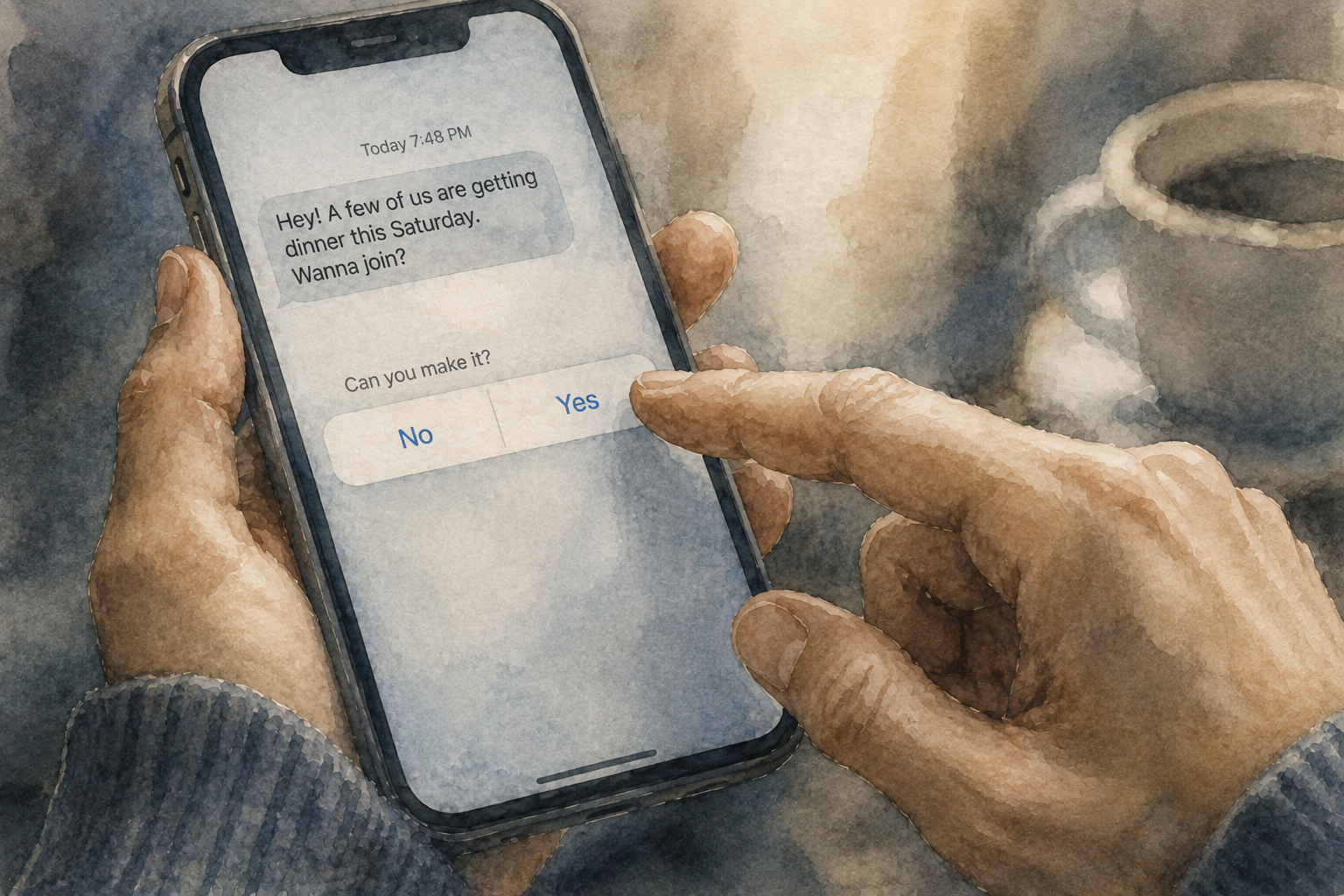
Your friend asks if you can help them move this weekend. You have plans. You're tired. You were looking forward to a quiet Saturday.
"Sure, yeah, of course!" you hear yourself say. The words are out before you even realize you've spoken.
You hang up the phone and feel it immediately—that heavy, sinking regret. The anger at yourself. The resentment already building toward a person who just asked a reasonable question and has no idea you didn't mean what you said.
You didn't want to say yes. But "no" didn't even feel like an option.
It's not just the big things. It's the small yeses that pile up until you're drowning in commitments you never wanted. The dinner you didn't want to attend. The favor you didn't have time for. The extra project at work you don't have bandwidth for. The conversation you didn't have energy for.
You say yes with your mouth while your whole body is screaming no. And later, when you're alone, you can't figure out why you keep doing this to yourself.
The yes that's actually a protection strategy
Here's what's happening: when you say yes and mean no, you're not being polite. You're trying to stay safe.
Your body learned, somewhere along the way, that saying no has consequences. Maybe it meant disappointing someone you loved. Maybe it meant conflict, anger, withdrawal. Maybe it meant being told you were selfish, difficult, ungrateful.
So you learned to say yes as a way to control the outcome. Yes meant approval. Yes meant safety. Yes meant you got to stay in the relationship, in the room, in someone's good graces.
And now, even when the stakes are low—even when the person asking would be fine with a no—your body still responds like saying no is dangerous.
The automatic yes isn't generosity. It's your body trying to avoid the pain it learned came with saying no.
For a lot of us, the pattern starts in childhood. Maybe your parents' love felt conditional, so you learned to say yes to stay close. Maybe saying no meant being shamed or punished. Maybe you watched someone else set a boundary and get rejected for it, so you learned that keeping the peace was safer than protecting yourself.
Or maybe it wasn't one big thing. Maybe it was a thousand small moments where your no didn't matter, didn't get heard, or got overridden. So you stopped offering it.
And now your body has a deeply embedded belief: saying no risks rejection. And rejection feels unbearable.
So you say yes. Even when it costs you. Even when you don't want to. Even when the resentment piles up so high you can barely see over it.
The math your body is running
Every time someone asks you for something, your body does a rapid calculation:
If I say yes: they'll be happy. I'll be safe. I'll avoid conflict. I'll prove I'm a good person.
If I say no: they'll be upset. They'll think I'm selfish. They might leave. I might be alone.
It happens so fast you don't even realize you're running the equation. You just know that yes feels safer, even when it makes your life harder.
But here's what that equation doesn't account for: the cost of chronic yes-saying.
The resentment that builds when you're constantly overriding your own needs to meet someone else's. The exhaustion of living a life shaped by other people's expectations. The relationships that become unbalanced because you never let anyone know what you actually need. The slow erosion of trust in yourself because you keep saying one thing and meaning another.
Every time you say yes when you mean no, you're teaching yourself that other people's comfort matters more than your own integrity.
And over time, that takes a toll. Not just on your schedule or your energy, but on your sense of self. You start to feel like a person things happen to, instead of a person who gets to choose. You lose track of what you actually want, because you've spent so long prioritizing what everyone else wants from you.
Why "just say no" doesn't work
If it were as simple as deciding to say no, you'd already be doing it.
But boundaries aren't a logic problem. They're something your body has to learn.
You can know, intellectually, that you're allowed to say no. You can know the other person will probably be fine. You can know that setting a boundary is healthy and necessary.
And still, in the moment, when someone asks you for something, your body will flood with anxiety. Your throat will tighten. Your brain will offer up every reason why saying no is the wrong move. And yes will come out of your mouth before you've even decided.
Because the part of you that learned to say yes isn't operating on logic. It's operating on survival. And it believes—deeply, truly—that saying no will cost you something you can't afford to lose.
So you can't just decide to start saying no. You have to teach your body that no is safe.
What actually helps
The first step isn't saying no. It's noticing the gap.
The next time you say yes and feel that immediate regret, pause. Don't shame yourself. Just notice: I just said yes. And I didn't mean it.
That's information. That's your body giving you a signal.
Then ask yourself: What was I afraid would happen if I said no?
Not what logically makes sense. What your body was afraid of. Disappointing them? Conflict? Rejection? Being seen as selfish?
Name it. You don't have to change it yet. You just have to see it.
Because once you start seeing the pattern—once you start recognizing the fear driving the yes—you can begin to challenge it.
You're not learning to be less kind. You're learning to include yourself in the equation — not just everyone else.
The next step is practicing no in low-stakes situations. Not the big boundary with your mother or your boss. Start smaller.
The friend who asks if you want to grab coffee when you're genuinely tired. The coworker who asks if you can cover a shift you don't want. The acquaintance who invites you to something you have zero interest in.
Pick one. And instead of yes, try: "Let me check my calendar and get back to you."
You're not saying no yet. You're just buying yourself time. Time to check in with your body. Time to let the automatic yes-reflex pass. Time to practice the tiny, terrifying act of not immediately prioritizing someone else's comfort over your own.
And then, when you're ready, you respond. Honestly. Even if it's hard.
The discomfort is part of the process
When you start saying no, it will feel awful.
Your body will send up every alarm it has. You'll feel guilty. You'll second-guess yourself. You'll worry the other person is upset. You'll want to take it back.
That discomfort isn't a sign you're doing it wrong. It's a sign you're doing something new. Something your system hasn't learned to trust yet.
And the only way through is to stay in it. To let the discomfort be there and notice that the catastrophe your body predicted doesn't happen.
They're not devastated. They don't hate you. They just... find someone else, or adjust, or say "okay, no problem."
And slowly—slowly—your body starts to update its data. It learns that no doesn't mean disaster. That you can protect your boundaries and still be loved. That other people's feelings are not your responsibility to manage at the expense of your own.
The next time yes comes out before you've checked in with yourself, you might notice. You might not. Either way, the regret that follows is information — your body telling you something got skipped.
Some people will be disappointed when you say no. Some won't. Disappointment isn't the same thing as harm, and harm isn't the same thing as a no.
Maybe the truth is hard to say. Maybe it gets easier, slowly, in the small situations first. Maybe it doesn't, not yet.
That's okay too.
Related book
Why Love Is So Complicated
Keep reading
- How to receive help without feeling like a burdenWhen someone offers help and your first instinct is to refuse—even though you need it—and what that reflex is protecting.
- You're not behind — you're on a different pathEveryone else seems on schedule while you're still figuring it out. There is no schedule — just your life, unfolding the only way it could.
- Why spending feels like relief (and then regret)The cart fills when something inside feels empty. For a moment spending helps — then the package arrives and the relief is already gone.