When AI starts doing your thinking for you
It's convenient. It's fast. And something in you is quietly forgetting how to figure things out. What happens when the answer arrives before the question has finished forming.
By Trupti Gavit
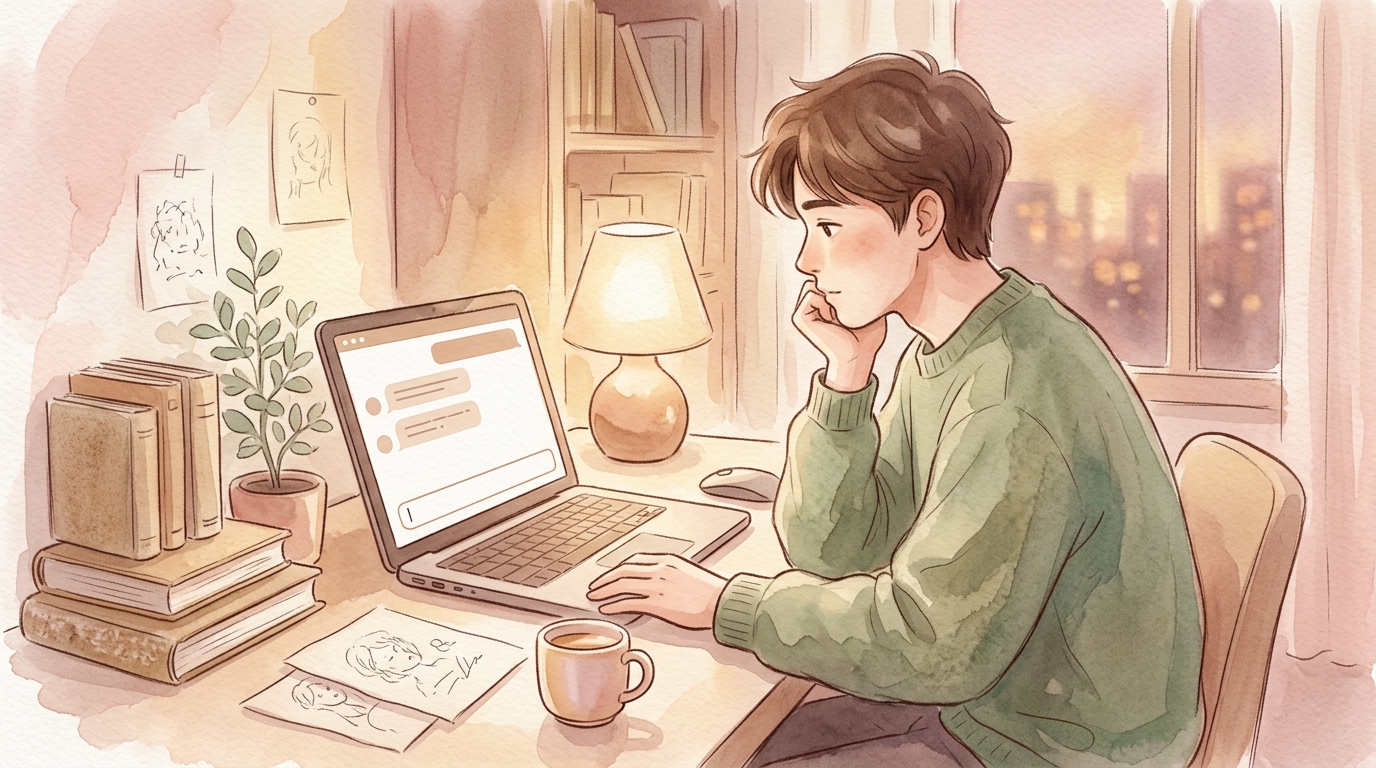
It's convenient. It's fast. And something in you is quietly forgetting how to figure things out.
You had a question — about wording, about a decision, about how to begin something you'd been putting off. You typed it into the chat box. The answer arrived in seconds, fluent and confident, and you copied it before you'd finished thinking about whether it was what you actually meant.
It felt like relief. It also felt, faintly, like skipping a step you used to take — the slow part, the uncertain part, the part where you sat with not knowing long enough for something true to surface.
You didn't notice the skipping at first. Nobody announces when a habit changes. It just becomes easier to ask than to wonder.
The answer before the sitting
Thinking, the slow kind, has a shape.
A question forms. You don't know the answer yet. You walk to the kitchen. You stare out the window. You write half a sentence and delete it. You talk it through with someone, or with yourself, and the talking is messy and unproductive and somehow necessary. Eventually something clarifies — not always correctly, not always permanently, but yours. Arrived at. Held in your own words.
AI compresses that shape. The question goes in. The answer comes out. The middle — the wandering, the wrong turns, the silence where nothing useful happens and something still moves — gets bypassed.
That bypass feels like efficiency. And sometimes it is. You needed a draft. You needed options. You needed to move. The tool helped.
But the bypass can also become default — the first reach when a question forms, before you've sat with it long enough to know what you're actually asking.
The answer can arrive before you've finished forming the question — and when it does, something in you stops waiting for your own words.
What gets quieter inside you
When answers come quickly from outside, an inner process can grow quieter.
Not gone. Not erased. Just less practiced. The muscle of staying with confusion — of tolerating the discomfort of not knowing, of writing badly until something honest emerges — doesn't atrophy dramatically. It softens. It becomes easier to skip. The skip feels harmless because the output is good enough.
You might notice this in small moments. An email you would have drafted yourself, now generated and lightly edited. A decision you would have sat with over tea, now resolved by a list of pros and cons you didn't write. A creative block that used to mean walking around the block until something loosened, now meaning opening a chat and asking for ten alternatives.
None of this is wrong. The tool is useful. The question is what happens to the part of you that used to do the slow figuring — and whether it still gets invited into your days.

Convenience and forgetting
Forgetting, in this context, isn't dramatic. It's subtle.
You forget what it feels like to sit with a blank page for twenty minutes. You forget that confusion can be productive — not pleasant, but productive — and that the answer you arrive at after struggling often fits better than the one that arrived instantly.
You forget that your own phrasing carries something — your rhythm, your hesitations, your particular way of meaning things — that a fluent generated answer might approximate but not hold.
You might prefer the approximation. It saves time. It sounds polished. It gets the job done. And slowly, without deciding to, you start trusting the outside voice more than the inside one — not because the inside voice is wrong, but because it takes longer and the longer way has competition now.
Convenience isn't the enemy. It's the speed at which something in you stops believing the slow way still counts.
When the tool becomes the first thought
This isn't a refusal of technology. It's a noticing — what happens when the tool becomes the first thought instead of the second or third.
You feel stuck. Before you feel stuck fully, you've already opened the chat. You need to write something. Before you write a word yourself, you've asked for a draft. You have a feeling you can't name. Before you sit with it, you've asked something to explain it to you.
Each choice is small. Each choice makes sense. But the accumulation matters — the way a path becomes a groove, the way the groove becomes the only way you remember walking.
Your thinking isn't gone. It's being rerouted — sent outward first, retrieved polished, accepted or edited lightly. The part that used to stay with the question long enough to surprise itself gets less room. And the surprise — the small jolt of your own insight arriving late, messy, true — gets less frequent too.
Holding two truths
You can use AI every day — for work, for learning, for the tasks that genuinely benefit from speed — and still notice when you're reaching for it before you've reached for yourself.
You can paste a generated answer and still let the moment before matter — the half-formed question, the confusion you didn't sit with, the words you might have found if you'd waited.
Neither truth cancels the other. Both live in the same person, the same laptop, the same ordinary need to move quickly and the same quiet question about what gets lost when nothing slow is required anymore.
A tool that thinks for you can still leave room for you to think — when the room stays open long enough for your own words to arrive.
The laptop is closed. The notebook is open to a page with one half-formed sentence — not good, not finished, but yours. The lamp throws a small circle of light across the desk. Outside, the evening is doing what evenings do, without waiting for you to articulate it. You might open the chat again tomorrow. You might sit with the blank page a little longer first. Either way, something in you remembers that figuring out has a pace — slow, uncertain, easy to skip — and that the skipping, however convenient, leaves a quiet space where your own voice used to be.
Related book
The Loop You're Stuck In
Keep reading
- What it means to feel less alone — even by one personYou don't need a crowd. You need one person who stays when things aren't pretty.
- Why the people who get you don't always get you right awayReal belonging takes time. The instant click is rare. The slow build is where trust lives.
- The exhaustion of performing connection without feeling itYou showed up. You smiled. You asked questions. And you drove home feeling emptier than before.