Why your bedroom matters more than you think
The room you sleep in speaks to your body all night. What a neglected bedroom says about how you're relating to yourself — and what changes when you treat it as yours.
By Trupti Gavit
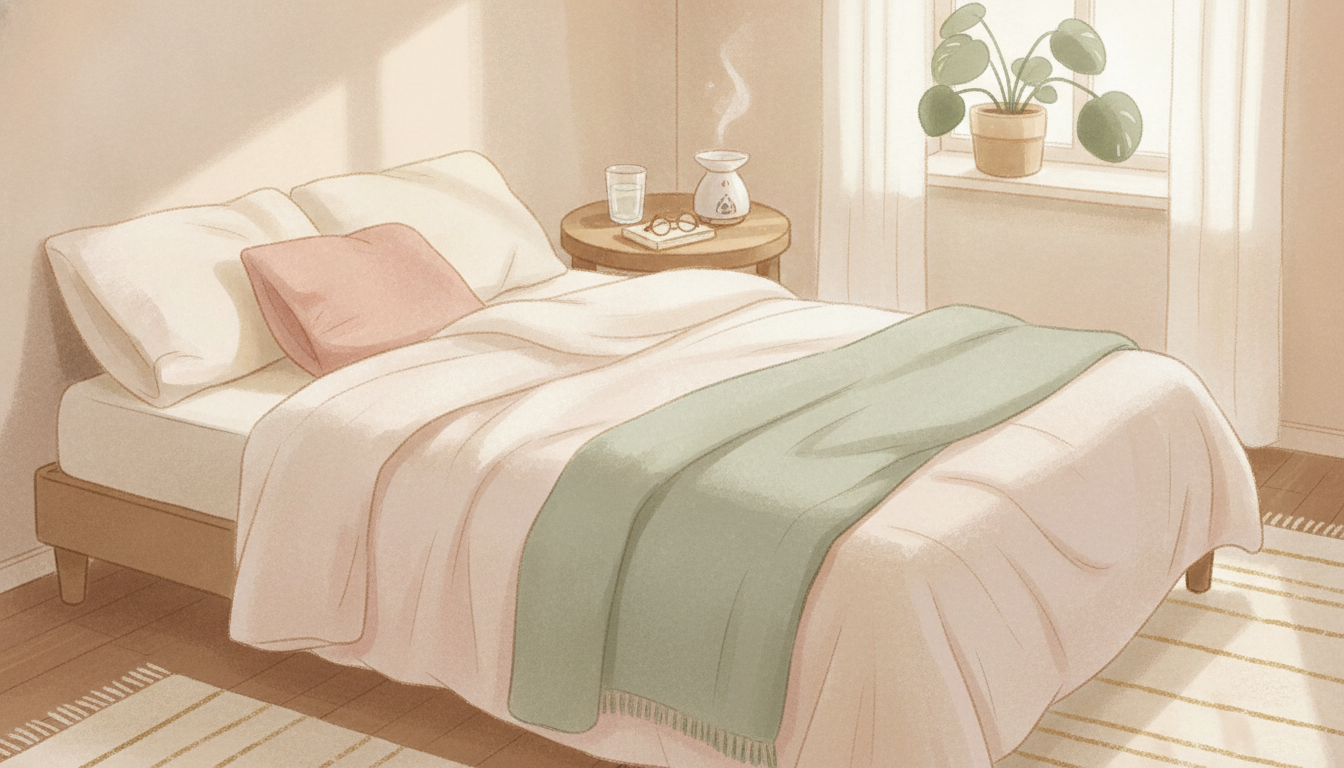
The room you sleep in speaks to your body all night.
Not in words. In temperature, light, the weight of sheets, the things your eyes land on when you wake at three a.m. and the ceiling is the only surface you can see. Your bedroom is the one room that holds you when you're most undefended — asleep, half-asleep, reaching for water in the dark, lying awake with a thought you can't turn off.
And yet it's often the last room we tend.
The living room gets the nice lamp. The kitchen gets cleaned because other people see it. The bedroom accumulates — laundry that didn't quite make it to the chair, the phone charger, the stack of things you'll deal with later, the overhead light that makes everything look slightly harsh at the hour when you most need soft.
We treat it like storage for the rest of life. A place to collapse, not a place that belongs to us.
What a neglected bedroom says
A bedroom doesn't judge you. But it does reflect something — often without you noticing.
When the sheets haven't been changed in weeks and you know it and don't change them anyway, that's a small message. When clothes live on the floor because the closet feels like too much effort, that's another. When the last thing you see before sleep is a pile of unfinished tasks and the first thing you see in the morning is the same pile, your body receives that as information about how much you matter in your own home.
This isn't about aesthetics. It's about relationship.
A neglected bedroom sometimes mirrors a neglected self — not because you're lazy or failing, but because you've been putting yourself last in the order of things that need care. The visible rooms first. The people who visit. The work that has deadlines. You, at the end of the list, in the room where no one else sleeps.
Your bedroom isn't a report card. But it often shows, quietly, how much room you've made for yourself in your own life.
The room where you are most yourself
Every other room in your home holds a version of you — the host, the worker, the person who answers the door. The bedroom holds the one who doesn't perform. The one who cries into a pillow. The one who reads the same paragraph three times. The one who wakes at four a.m. and doesn't know why.
That person needs a room that speaks kindly.
Not a showroom. Not the bedroom from a catalog. Just a room that says, in small ways: you live here too. Sheets that feel clean against your skin. A nightstand that isn't a landing pad for everything you couldn't put away. Light that doesn't assault you when you're already tired. Air that isn't stale from a door that hasn't been opened in days.
These aren't luxuries. They're the basic grammar of a room that knows who it's for.
Sleep and the space that holds it
Sleep isn't only about hours. It's about what surrounds the hours — the transition into them, the quality of waking inside them, the half-light moments when your body decides whether the night felt safe or merely survived.
A bedroom that stays bright until you drop your phone on your face teaches your body that alertness and rest share the same address. A room that's too cold, too cluttered, too full of the day's unfinished business — your sleep may arrive, but it might not land fully. You might wake tired without knowing why, as if the room kept a conversation going all night that you couldn't hear consciously.

Renovation isn't required. One thing your body touches every night might shift the room — fresh sheets, a glass of water already on the table, curtains that actually darken the room, the phone charging somewhere farther from the pillow. Not as a rule. Just a small boundary between the day's noise and the night's quiet.
Sleep happens in a room, not in an idea. What that room holds — and what it leaves out — talks to your body for hours you don't remember.
When tending the bedroom feels hard
Sometimes the bedroom is hard to enter, hard to stay in, hard to care for — not because you're incapable, but because the room holds something.
The bed where you got the call. The wall you stared at during the worst month. The mattress that knows your insomnia better than anyone. Tending a room can mean tending memory, and memory doesn't always welcome the broom.
What happened there doesn't have to be erased. Sometimes the room still looks like the person who needed to survive in it — and you've changed since then, and the room hasn't caught up.
One change — sheets, light, clearing the surface beside the bed — isn't denial. It's a small update to a relationship. I'm still here. Maybe this room can reflect that now.
You might not have energy for a full reset. That's fine. The bedroom doesn't need your best day. It needs one gesture on an ordinary evening — a pillow plumped, a window opened, the glass of water refilled — small signs that the person sleeping here is still someone worth preparing for.
A sanctuary isn't a perfect room
Sanctuary doesn't mean pristine. It doesn't mean minimal or expensive or worthy of a photograph.
It means a room where your body can soften. Where waking up doesn't immediately feel like a task. Where the last thing at night isn't a scroll through other people's lives, but something closer to your own — a book, a dim lamp, the simple fact of horizontal rest in a space that isn't asking you to be anyone other than the person going to sleep.
Your bedroom can be messy and still be yours. It can be small, shared, rented, temporary. What makes it a sanctuary isn't the size or the style — it's whether you've treated it as a place where you belong, not just a place where you store yourself until morning.
You might share the bed with someone, or with a pet, or with the memory of someone who used to sleep beside you. A sanctuary doesn't require solitude. It requires one corner of the night where your body isn't bracing — where the room, in some small way, is on your side.
A sanctuary isn't a room that impresses anyone. It's a room that greets your body as worth tending — especially in the hours when no one else sees you.
The sheets are cool against your legs. The room is dimmer than it was last week — not transformed, just slightly more yours. Outside, the world continues its loud motion. In here, your body is horizontal, held by four walls that finally, in some small way, know who they're for. The night arrives. No case needs to be made.
Related book
The Loop You're Stuck In
Keep reading
- What it means to feel less alone — even by one personYou don't need a crowd. You need one person who stays when things aren't pretty.
- Why the people who get you don't always get you right awayReal belonging takes time. The instant click is rare. The slow build is where trust lives.
- The exhaustion of performing connection without feeling itYou showed up. You smiled. You asked questions. And you drove home feeling emptier than before.