Why you choose familiar over good
The healthy choice feels unfamiliar — and unfamiliar feels unsafe. Why your body sometimes prefers what it knows over what's kinder.
By Trupti Gavit
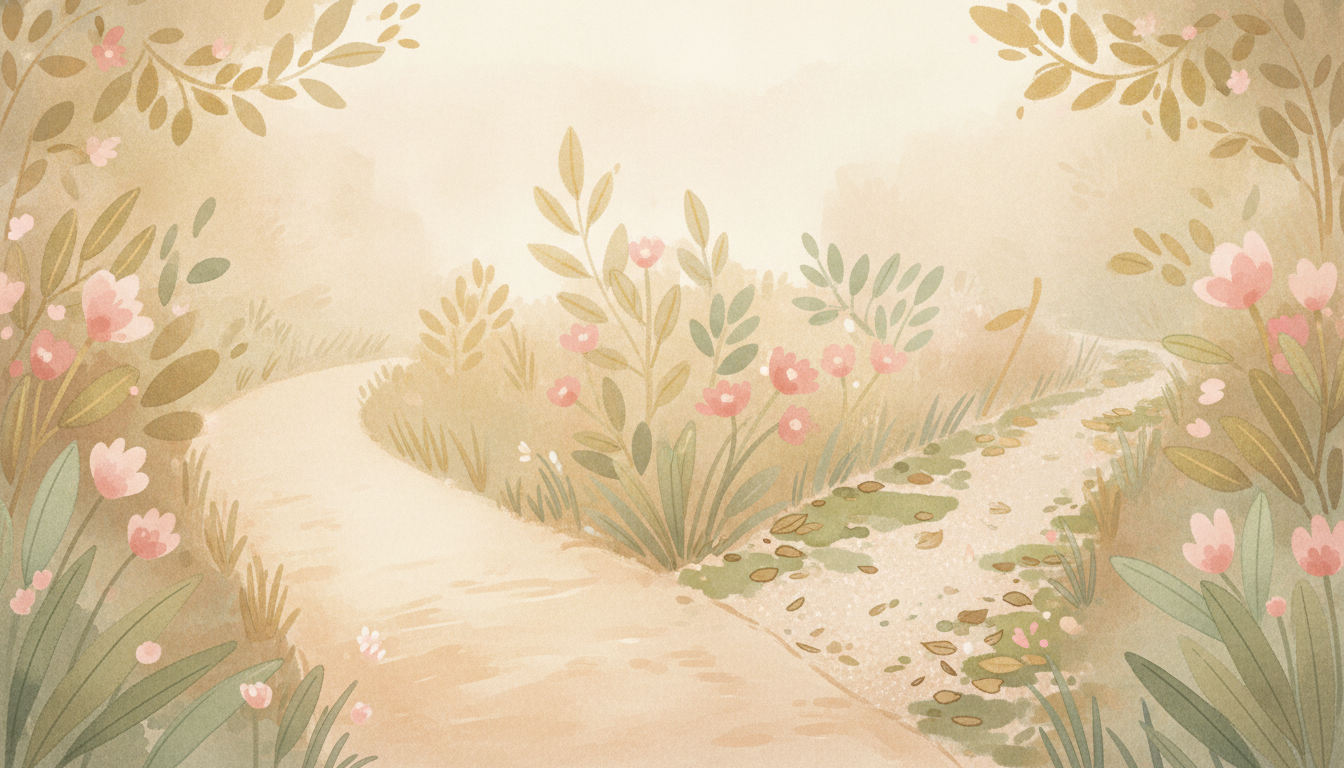
The healthy choice feels unfamiliar — and unfamiliar feels unsafe.
You're standing in the doorway of a decision you can already feel in your body before you've made it. On one side: the person who texts back, who listens without turning it into a lecture, who doesn't make you earn their warmth. On the other: the pull toward what's known — the dynamic you could navigate in your sleep, the rhythm of closeness and distance you've danced before, the ache that somehow still feels like home.
You know which one is kinder. You know which one costs you less.
And still, your feet hesitate on the threshold. Because good, in this moment, doesn't feel like relief. It feels like standing in a room where you don't know where anything is.
What familiar actually means to your body
Familiar isn't the same as happy. Familiar is what your body has mapped — the terrain it knows how to walk, even when the ground is uneven.
If you grew up around volatility, your body learned to read spikes and drops as connection. If love was inconsistent, you learned to scan for signs. If closeness came with conditions, you learned to perform, adjust, anticipate.
Those patterns aren't abstract. They're physical. They're the way your chest tightens before a phone call. The way relief floods you after days of silence when someone finally responds. The way you know exactly what to do when someone withdraws — because you've practiced that choreography a hundred times.
Your body isn't choosing pain. It's choosing a language it already speaks.
So when something genuinely good appears — steady, clear, without the familiar push and pull — your body doesn't register it as safe. It registers it as blank. Unknown. A room with no furniture you recognize.
That's not weakness. That's wiring. And it explains so much of what looks, from the outside, like choosing the harder path again — like leaving when things get calm, like finding reasons to doubt the one who simply stays.
The comfort of a known script
There's a strange ease in relationships that hurt in predictable ways. You know the steps. You know when to be smaller, when to give more, when to brace. You know how the story goes — the tension, the rupture, the brief sweetness that follows, the hope that this time it will be different.
With someone who doesn't run that script, you don't know what to do with your hands.
There's no crisis to manage. No mood to decode. No version of yourself you need to become to keep them from leaving. You just get to show up — and if you've spent years believing that showing up as yourself wasn't enough, that can feel more frightening than the old ache ever was.

You might catch yourself creating friction where none exists. Reading distance into a quiet evening. Interpreting kindness as boredom. Pulling back to see if they'll chase — not because you want to play games, but because chase-and-return is a shape your body understands.
This isn't about wanting suffering. It's about wanting coherence — the sense that what you're feeling matches a story you've survived before.
When good feels like nothing
People say follow what feels right. But for some of us, "right" has always been tangled up with intensity — the flutter of uncertainty, the relief after fear, the aliveness that comes from not knowing where you stand.
Calm doesn't flutter. Steady doesn't spike your pulse. Someone who says what they mean and means what they say doesn't give you the chemical weather you've learned to call love.
So you say they're boring. Or too nice. Or not enough of something you can't quite name.
What you might mean is: they're not activating the pattern. And without the pattern, you don't know if you're connected at all.
Intensity isn't proof of depth. Sometimes it's just the body recognizing an old song and calling it home.
This is the part that's hard to say out loud — that you might miss the chaos even while you're exhausted by it. That the relationship that costs you sleep might still feel more real than the one that lets you rest. That choosing good requires tolerating a season of not-knowing, and not-knowing has rarely been safe for you.
You're not failing for feeling this way. You're carrying a map drawn in a different country. And of course the new landscape feels wrong at first — not because it is, but because you haven't walked it enough times for your feet to trust the ground.
Two truths can live in the same room
You can know someone is good for you and still feel the pull toward what's familiar. You can want the steady person and grieve the intensity you're leaving behind. You can be proud of choosing differently and lonely in the unfamiliar quiet.
Both are true. Neither cancels the other.
Choosing familiar over good isn't a moral failure. It's what happens when a body that learned to survive through watchfulness meets a situation that doesn't require watchfulness — and interprets the absence of alarm as absence of meaning.
You don't have to shame the pull. You can see it. Name it. There's the old road. I know every turn. And here's the new one — I don't know where it leads yet.
Choosing good doesn't mean the familiar stops calling. It means you learn to hear both voices and still take one step on the new path.
You don't have to feel ready. You don't have to feel certain. You only need enough willingness to stay in the unfamiliar a little longer than your body wants to — long enough to gather evidence that calm isn't emptiness, that consistency isn't a trick, that someone can be kind on Tuesday and still be kind on Wednesday.
That evidence comes slowly. A text returned without subtext. A disagreement that doesn't become a withdrawal. A ordinary evening that doesn't feel like the quiet before something shatters.
What becomes possible when you stay
The unfamiliar phase doesn't last forever. At some point, if you let yourself remain, the new path develops its own wear — its own ease, its own small rituals, its own kind of warmth that doesn't require recovery afterward.
You stop scanning for the catch. You stop testing to see if they'll leave. You start to notice love in unremarkable forms — someone remembering how you take your tea, someone making room for your bad day without making it theirs, someone staying when there's nothing dramatic to stay for.
It won't feel like fireworks. It might feel like Sunday morning. Like two cups on the same table. Like a life you don't have to perform to keep.
And somewhere alongside the new ease, the old familiar might still whisper sometimes. That's okay. You don't have to silence it. You only have to stop letting it steer every time it speaks.
Choosing good when good feels unfamiliar doesn't ask you to feel ready. It only asks you to stay in the room a little longer—long enough to notice where the light comes in, if it comes in at all.
Related book
Why Love Is So Complicated
Keep reading
- What it means to feel less alone — even by one personYou don't need a crowd. You need one person who stays when things aren't pretty.
- Why the people who get you don't always get you right awayReal belonging takes time. The instant click is rare. The slow build is where trust lives.
- The exhaustion of performing connection without feeling itYou showed up. You smiled. You asked questions. And you drove home feeling emptier than before.