The feeling right before you pick up your phone
There's a tiny gap between the impulse and the action. That gap is where something quiet lives — a feeling arriving before your hand knows what to do with it.
By Trupti Gavit
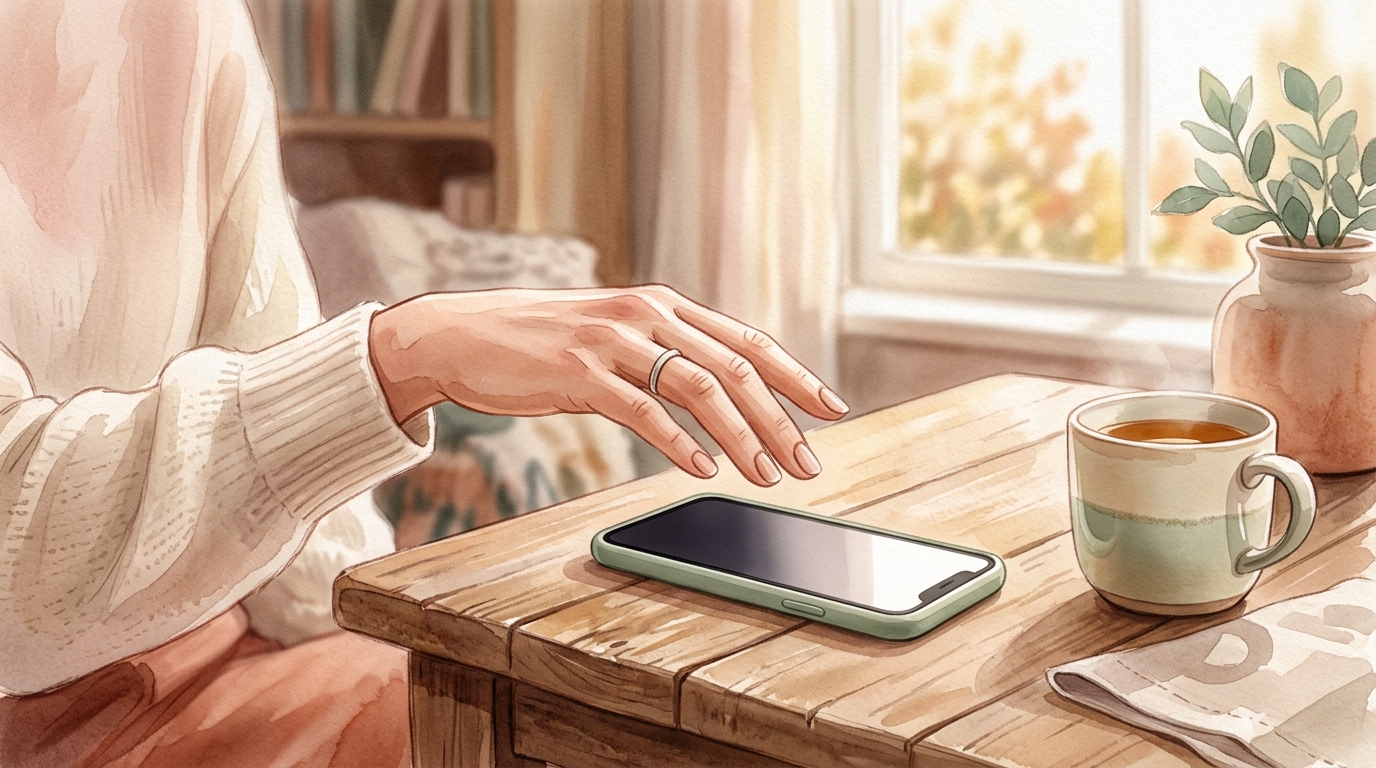
There's a tiny gap between the impulse and the action. That gap is where something quiet lives.
You feel it sometimes — if you're fast enough to catch it. A half-second, maybe less. Something stirs in your body. Restlessness, maybe. Or heaviness. Or a small flutter of something that doesn't have a name yet. And then your hand moves. Pocket. Bag. Table. Screen. The light comes on and the feeling scatters — or buries itself underneath whatever you start looking at.
Most of the time you miss the gap entirely. The impulse and the action feel like one motion. But they aren't. Something happens in between. A feeling arrives. A need forms. A body remembers that the phone has answered this before.
That gap is small. It's also real.
The feeling you reach past
The pickup rarely starts with the phone. It starts with a sensation — subtle enough to ignore, familiar enough that your body knows what to do next.
Boredom, sometimes. The flat stretch of a day with no edges. Loneliness — not the dramatic kind, just the quiet sense that no one is thinking of you right now. Anxiety about something later, or something you can't change, or nothing you can identify. Restlessness in your hands when your mind has been still too long, or stillness in your mind when your hands have been busy too long.
The feeling doesn't announce itself. It arrives as impulse — a pull toward the pocket, the drawer, the bag. By the time you notice you're reaching, you're often already past the feeling that started it.
The phone isn't the first thing that happens. The feeling is. The phone is just where the feeling goes when it doesn't know where else to go.
What lives in the half-second
If you could slow the moment down — not to stop it, just to see it — you might notice a sequence.
Stillness. Then discomfort, or emptiness, or a flicker of something unresolved. Then the impulse — not a thought, exactly, but a body-memory: this has helped before. Then the hand. Then the screen. Then the feeling either dissolves or waits underneath while you scroll.
That half-second before the hand moves is the most honest part of the whole sequence. The feeling is still visible there. It hasn't been covered yet. It hasn't been split by a feed or diluted by motion.
Most of us blow past it without knowing it existed.

Different feelings, same reach
Not every pre-pickup feeling is the same. Learning to tell them apart — even roughly — can change what the reach means.
Restless boredom sends you looking for novelty. Something new. Something to break the flatness. Loneliness sends you looking for presence — a message, a face, a sign that someone is out there. Anxiety sends you looking for control — information, reassurance, the small comfort of checking whether the thing you're worried about has changed.
Fatigue sends you looking for rest that isn't rest — numbing, motion, the appearance of doing something when doing nothing feels impossible.
The reach looks identical from the outside. Inside, the feelings are different. And different feelings might ask for different responses — not always the phone, not always putting the phone down, just something more precise than a reflex.
The impulse to reach is rarely about the phone. It's about the feeling that arrived a breath before — and whether you had a place to put it.
Staying in the gap without forcing anything
You don't have to master the gap. You don't have to always pause, always breathe, always choose differently. That turns noticing into another performance — and performance is its own kind of noise.
Sometimes staying in the gap just means catching it once. Feeling the restlessness without immediately answering it. Naming the loneliness — even silently — before the thumb moves. Letting the anxiety sit for three seconds and discovering it doesn't actually require a screen to survive.
The gap doesn't need to become a practice you perform perfectly. It can be a single moment on a random Tuesday — your hand hovering, the feeling still visible, the day unchanged except that you noticed.
Sometimes you still pick up the phone. That isn't failure — just what happened. The gap was seen. That counts.
When the feeling gets a name
Something changes when a word arrives — even a small one, even one you don't say out loud.
The general wrongness becomes I'm lonely. The vague urgency becomes I'm dreading tomorrow. The restlessness becomes I'm bored and I don't want to be alone with the boredom.
Naming doesn't make the feeling disappear. It makes it less fog-like. And fog is harder to stay with than something that has edges — even uncomfortable edges.
You might still reach after naming it. But the reach becomes a choice in a way it wasn't before — or at least a choice you can see, which is a kind of choice all its own.
The gap doesn't ask you to be different. It asks you to arrive a breath earlier — when the feeling is still visible and the hand hasn't decided yet.
Holding two truths
You can reach for the phone most of the time — and also notice, once in a while, the feeling that arrives a breath before your hand moves.
You can pick up the phone after naming the loneliness — and still let the naming matter, even when the reach doesn't change.
Neither truth cancels the other. Both belong in a day that asks a lot of your attention.
The phone is still on the table. Your hand is in your lap. The feeling that started this — restlessness, loneliness, something without a name — hasn't gone anywhere. It sits in the room with you, quieter now that the reach didn't happen automatically. You don't have to do anything with it. You don't have to solve it or sit with it until it transforms. You noticed the gap. You stayed inside it for one breath. That's already a different relationship to the impulse — not mastery, not triumph, just presence. The light moves across the table. The phone waits. So do you.
Related book
The Loop You're Stuck In
Keep reading
- What it means to feel less alone — even by one personYou don't need a crowd. You need one person who stays when things aren't pretty.
- Why the people who get you don't always get you right awayReal belonging takes time. The instant click is rare. The slow build is where trust lives.
- The exhaustion of performing connection without feeling itYou showed up. You smiled. You asked questions. And you drove home feeling emptier than before.