How financial anxiety shows up in relationships
The argument wasn't about the restaurant bill — it was about what money means to each of you, and what your bodies learned before you ever shared an account.
By Trupti Gavit
You're standing at the kitchen counter with your phone open to the banking app. Your partner is rinsing a plate. The water runs. Neither of you is looking at the other.
The argument started over dinner — who should pay, whether the restaurant was too expensive, whether you needed to go out at all. But by the time you got home, it had already moved somewhere else. Into the old territory where a number on a screen becomes a verdict. Where spending feels like carelessness to one person and survival to the other. Where silence after a purchase can mean a whole afternoon of bracing.
It's never just about the bill — it's about what money means to each of you.
When the spreadsheet becomes a story
Money in a relationship rarely stays in the category of math.
For one person, a shared expense might mean partnership — we're building something together. For the other, it might mean exposure — now someone can see how I manage, how I fall short, what I don't know.
You might notice this in small moments before the big fights arrive. The pause when your partner suggests a vacation. The way your chest tightens when they mention their salary. The relief you feel paying for something yourself, even when splitting would be simpler — because owing can feel like owing more than money.
Financial anxiety in love isn't usually about the amount. It's about what the amount says about safety, worth, and whether you'll still be held if the numbers change.
Maybe you grew up watching someone hide bills in a drawer. Maybe you learned that generosity came with strings, or that asking for help meant losing standing in the room. Maybe you had enough once and then didn't, and your body still lives in the aftershock of that shift.
Your partner has their own version of this story. Different details, same language underneath: Will I be okay? Will you stay? Am I too much? Am I not enough?
The ways it moves between you
Financial anxiety doesn't always announce itself as worry. Sometimes it arrives dressed as control — checking accounts, questioning purchases, needing to know where every rupee went. Sometimes it arrives as avoidance — changing the subject, refusing to look, agreeing to plans you can't afford and resenting them later.
Sometimes one person spends when stressed and the other hoards when scared, and both behaviors can look like personality from the outside when they're really two bodies trying to feel steady.
You might become the one who always says no to plans, not because you don't want to go, but because saying yes feels like stepping onto ice. You might become the one who covers everything, then feels unseen when gratitude doesn't arrive the way you needed. You might split everything evenly on principle while something quieter festers — the sense that fair and safe are not the same word.

Neither of you is wrong for having a body that learned what it learned. The trouble begins when the story runs faster than the conversation — when a receipt becomes proof, when a pause hardens before anyone names the fear underneath, when love gets translated entirely into who paid for what.
What you're actually protecting
Underneath most money fights is a question neither person says out loud.
If I need more, will you think less of me? If I earn more, will I become the one who holds everything? If we merge our lives, do I lose the part of me that survived by staying careful?
These aren't financial questions. They're closeness questions wearing numbers.
You might find yourself angry at a small purchase because it touched an old fear — not enough, never enough, the floor might drop. Your partner might hear criticism where you meant caution. You might hear indifference where they meant trust.
The fight about the bill is often a fight about whether closeness makes you safer or more visible — and visibility, for some bodies, still feels like risk.
This is why logic rarely ends these arguments. You can show the spreadsheet. You can prove the expense was reasonable. You can agree on a budget with calm voices and good intentions. And still, the next month, something in your chest will tighten when the notification arrives — because your body isn't arguing about this month. It's remembering other months.
When difference doesn't have to mean distance
Two people can carry different money stories and still build something steady. But steadiness rarely comes from one person's version of rightness carrying the whole room.
It comes from slowing down enough to name what the number activated — when I saw that charge, I felt the old fear of not having enough instead of you spent too much. Or when you ask about every purchase, I feel like I'm back in a room where I had to report myself instead of you're being controlling.
These sentences are harder than accusations. They ask you to stay in the feeling long enough to translate it — and ask the other person to hear the fear without defending their math.
You don't have to merge every instinct to share a life. One of you might need more visibility. One might need more autonomy. Both needs can live in the same relationship if they're spoken instead of performed through tension.
Small honesty at the table
You won't rewrite your money stories in one conversation. They were written over years — in kitchens where voices rose over bills, in years when a good month didn't guarantee the next one, in moments when love and provision got tangled until you couldn't tell which you were asking for.
What you can do is bring those stories into the room before they hijack the evening.
That might look like naming your default — I get quiet when money comes up because I learned to handle it alone. It might look like asking what safety means to each of you, not what the account should look like. It might look like leaving space for the fact that you can love someone deeply and still flinch at sharing a balance.
Money asks something tender of love: can we be honest about fear without making each other the cause of it?
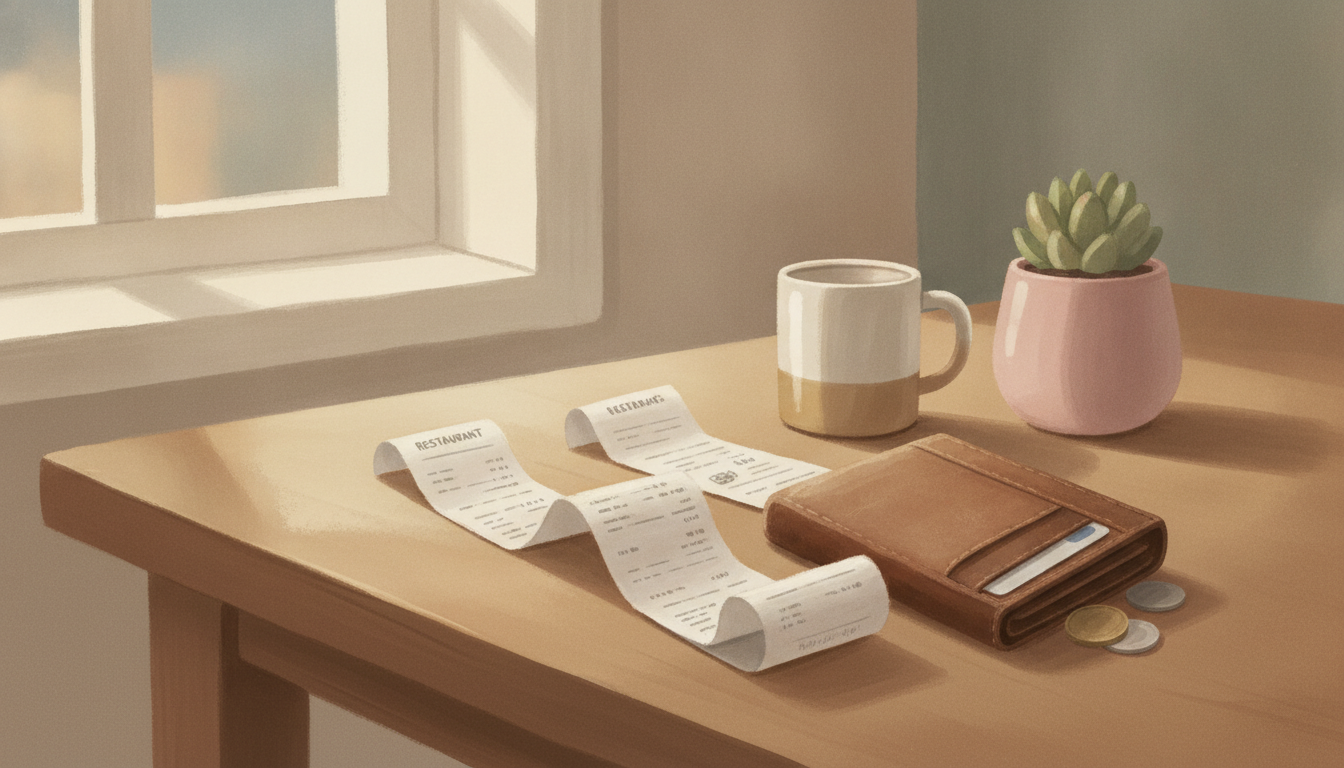
The receipts are still on the table. The wallet is closed. The water in the sink has stopped running. You don't have to agree on everything tonight — only to stay in the room long enough for the number to become two people again, not a verdict waiting to land.
Related book
Why Money Hits So Deep
Keep reading
- What it means to feel less alone — even by one personYou don't need a crowd. You need one person who stays when things aren't pretty.
- Why the people who get you don't always get you right awayReal belonging takes time. The instant click is rare. The slow build is where trust lives.
- The exhaustion of performing connection without feeling itYou showed up. You smiled. You asked questions. And you drove home feeling emptier than before.