Why friendship gets harder as you get older
The group chat goes quiet. Schedules don't align. Loneliness arrives not as drama — just as distance.
By Trupti Gavit
You open the group chat and scroll up.
Last message: eleven days ago. Someone sent a meme. Two people reacted with a heart. Then silence — not angry silence, not the kind that follows a fight. Just the quiet that happens when everyone's calendar is full and no one has the bandwidth to be the one who texts first again.
You type something — hey, been a while — and delete it. Not because you don't mean it. Because you're not sure what you'd say after that. Because the last three times you reached out, the conversation stayed pleasant and thin, like tea that's been sitting too long: warm enough, but not quite what you were thirsty for.
You put the phone down. The apartment is fine. You had a good day. And still, something settles in your chest — not grief exactly, more like a room where the chairs are still there but no one's sitting in them.
Everyone's busy. Everyone's guarded. And loneliness sneaks in quietly.
When friendship stopped being automatic
There was a season when friendship didn't require scheduling. You saw the same people because you shared a classroom, a dorm hallway, a first job where everyone was new and no one had children yet or aging parents or mortgages that made a Tuesday evening feel like a luxury.
Friendship happened in the margins — walking to the bus, staying late after a meeting, running into someone at the grocery store and talking for twenty minutes in the frozen aisle.
Then life rearranged itself. People moved. Couples formed. Babies arrived. Careers thickened. The margins disappeared, and friendship became something you had to put in the calendar between dentist appointments and grocery runs.
That shift isn't anyone's fault. It's the texture of growing older — time becoming finite in a way it wasn't at twenty-two, when next week felt infinite and a free evening didn't need to be defended.
Friendship didn't leave because people stopped caring. It thinned because life got heavier, and heavy things take both hands.
The guardedness no one talks about
Busy is only part of it.
The other part is that you know more now. You've been disappointed. You've shown up fully and watched the friendship fade anyway. You've shared something tender and watched it become awkward small talk at a party. You've learned, slowly, that not every person who feels close is safe to be close to — and that lesson doesn't always announce itself cleanly. It arrives as hesitation.
So you hold back a little. You keep conversations light. You answer how are you with good, busy, you know how it is because the true answer — the one about the marriage strain, the parent who's failing, the anxiety that won't leave — feels too large for a text thread between meetings.
They might be doing the same thing. Two people standing at opposite edges of a pool, both wanting to wade in, both remembering the last time the water was colder than it looked.
That guardedness isn't cynicism. It's care — for your own heart, for other people's time, for the version of yourself that learned visibility could cost something.
The loneliness that doesn't look like loneliness
You might not call it loneliness because you still have people.
You have coworkers you like. You have family you talk to. You have friends from before who send birthday messages and heart-react your photos. You might even see someone once a month for coffee and leave feeling genuinely glad you went.
And still — there can be a gap between being known and being held. Between having people to call in an emergency and having someone who would understand why a small thing ruined your whole afternoon. Between company and companionship.
That gap is quiet. It doesn't always show up as tears or dramatic isolation. It shows up when you finish a good book and realize you don't know who to tell. When something funny happens and the person you'd text first hasn't spoken to you in weeks. When you get good news and feel, briefly, alone with it.

You can be surrounded and still miss the particular warmth of being known without explanation.
What changed in you, gently
It's tempting to compare your current social life to a highlight reel — college weekends, that year everyone lived in the same neighborhood, the friend group before the first big move.
But you aren't the same person who lived inside those seasons. You've been shaped by what you've carried since. Some friendships didn't end; they outgrew their container. Some people you loved simply moved in a direction your paths no longer share.
That isn't failure. It's the ordinary drift of lives that are still being lived.
You might also notice you've become more selective — not because you're arrogant, but because your energy is limited and you want to spend it where reciprocity lives. Where showing up doesn't feel like performing. Where silence isn't punishment.
That selectivity can make friendship feel harder. There are fewer people in the inner circle, and each connection matters more — which makes the distance hurt more when it appears.
The small reach that still counts
Friendship in adulthood rarely looks like the movies. It looks like a voice memo while you're walking the dog. A postcard for no reason. Showing up with soup when you heard someone's sick, even if you haven't spoken in two months.
It looks like being the one who texts first — not every time, not with resentment, but sometimes, because someone has to reopen the door and it might as well be you.
It also looks like letting some friendships become seasonal — people you love who belong to a chapter, not a daily rhythm. That can ache and still be honest.
A friendship doesn't have to be constant to be real. Some connections breathe — close, then distant, then close again.
You can't force depth. You can't schedule intimacy the way you schedule a dentist appointment. But you can leave the door ajar — a message that says I thought of you, an invitation without pressure, a willingness to be slightly more visible than feels comfortable.
Some people won't meet you there. That stings, and it's not a reflection of your worth. Others will — slowly, tentatively, grateful someone spoke first.
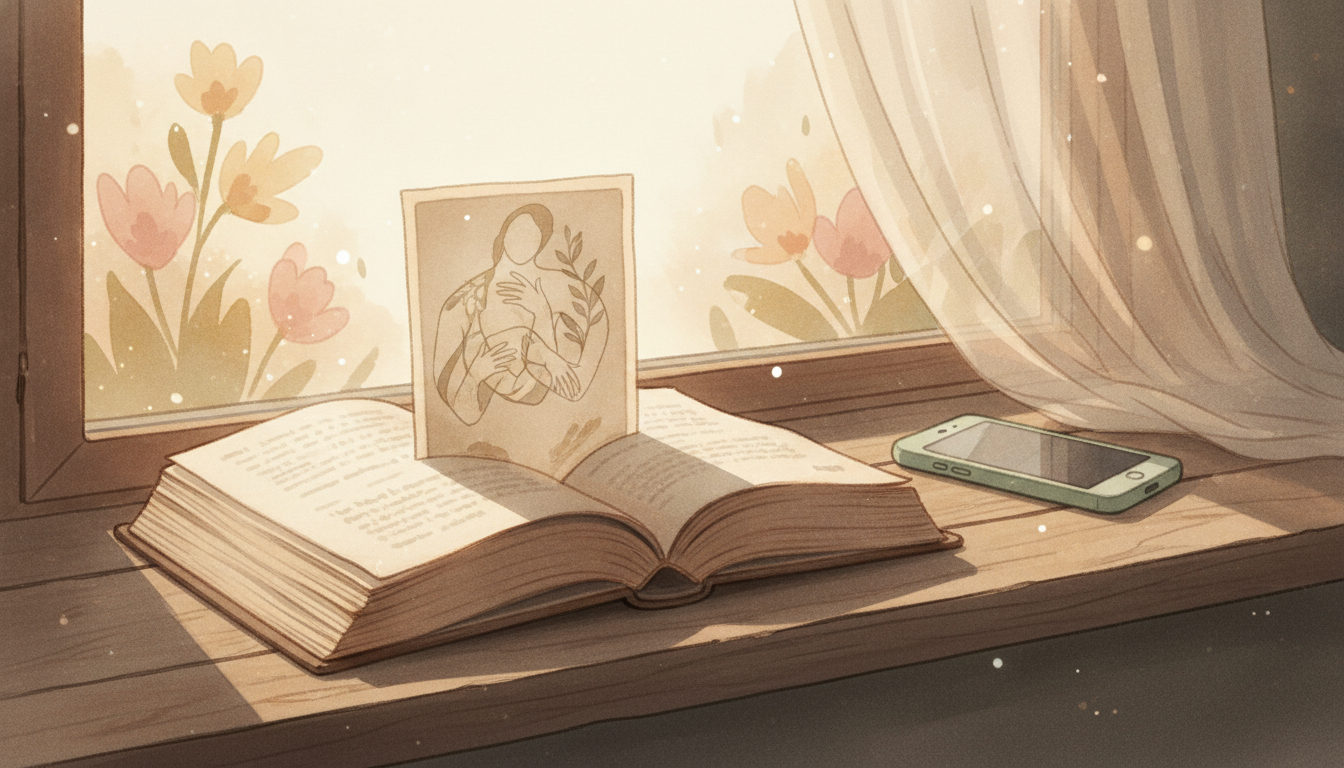
The photograph on the windowsill
There's a particular kind of missing that isn't about any one person. It's about the ease you remember — or think you remember — when connection didn't require negotiation.
The old photograph in the book. The group chat that used to buzz all day. The friend who knew your coffee order without asking.
You can miss that and still be building something different now. Slower friendships. Fewer but truer. The kind that don't need daily proof because both people understand that life is loud and showing up when you can is its own language.
The group chat is still quiet. Your message might sit there unread for a day, or two, or it might come back with something small and real. Either way, the afternoon light moves across the windowsill. The photograph stays tucked in the book — not gone, just from another season. And somewhere, another person might be scrolling past the same silence, wondering if they're the only one who feels it.
Related book
Why Love Is So Complicated
Keep reading
- What it means to feel less alone — even by one personYou don't need a crowd. You need one person who stays when things aren't pretty.
- Why the people who get you don't always get you right awayReal belonging takes time. The instant click is rare. The slow build is where trust lives.
- The exhaustion of performing connection without feeling itYou showed up. You smiled. You asked questions. And you drove home feeling emptier than before.