Why you get headaches from holding things in
You didn't argue — but your body absorbed the tension anyway. When the words stay inside and your head carries what your voice never said.
By Trupti Gavit
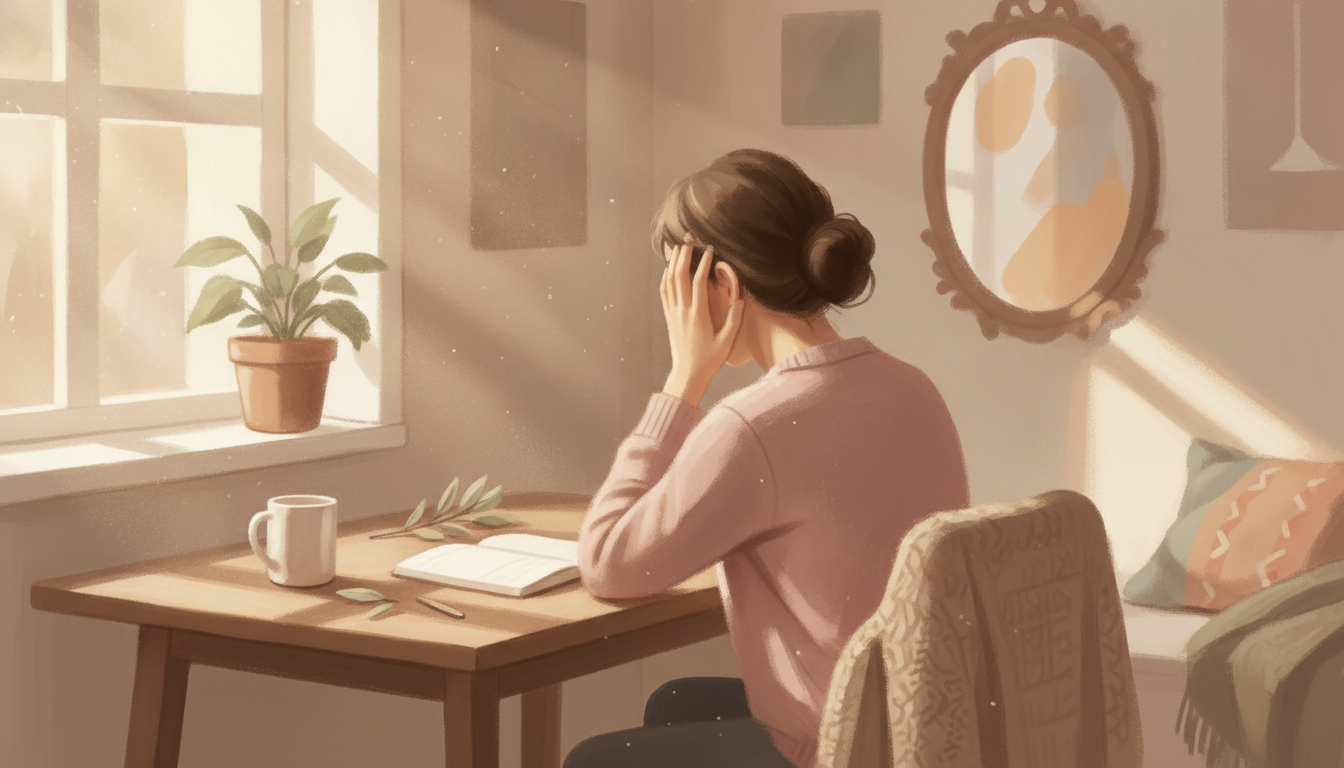
The meeting ended without conflict. You nodded. You smiled. You said "sounds good" when something didn't sound good at all.
You drove home. Made dinner. Answered texts. By eight o'clock, a headache had settled behind your eyes — not sharp, just persistent, like a low hum you can't locate.
You didn't argue. You didn't raise your voice. You didn't make a scene.
But your body absorbed the tension anyway.
When keeping the peace costs your body
There's a particular kind of strain that comes from swallowing what you wanted to say.
Your jaw tightens around words that never leave. Your shoulders climb toward your ears and stay there. Your breath gets shallow — not because you're panicking, but because full breaths feel like they might carry something out that you're not ready to release.
Headaches often live in this territory. Not always from one dramatic moment. More often from accumulation — the hundred small times you said yes when you meant no, the conversations you replayed instead of having, the feelings you filed away because the room didn't feel safe enough for them.
Your mind might call it being mature. Being easy. Keeping things smooth.
Your body keeps a different ledger.
What you don't say out loud, your muscles often say for you — in the jaw, the neck, the space behind your eyes.
The body that learned to hold
Many of us were taught — without anyone saying it directly — that our feelings were inconvenient.
Maybe speaking up led to punishment or withdrawal. Maybe the adults around us were already carrying enough, and we learned to add nothing. Maybe conflict felt dangerous, and silence felt like the kindest option available.
So we got good at holding. Good at compressing irritation into a pleasant expression. Good at letting the moment pass and dealing with the feeling alone, later, in the car or the shower or the dark.
The body remembers that compression. It doesn't distinguish between I chose not to speak and I wasn't allowed to speak. It just registers: tension in, tension stored. And the head — with its web of small muscles, its proximity to the jaw and neck — is often where stored tension announces itself.

What a headache might be carrying
Not every headache is emotional. Sleep, dehydration, screens, weather — all of it matters.
But if you notice a pattern — headaches after meetings where you stayed quiet, after family dinners where you performed fine, after days when you smiled through something that hurt — it might be worth asking what your body is still holding.
Not to diagnose yourself. Not to turn every physical sensation into a metaphor. Just to notice the overlap. My head hurts. I also didn't say what I meant today. Both of those things are true.
Sometimes the headache loosens when you finally name the feeling — even privately, even in a journal no one reads. I was angry. I was hurt. I wanted to leave and I didn't. The body doesn't always need an audience. It sometimes just needs to know that you heard it.
Your body isn't punishing you for being quiet. It's asking, gently and persistently, whether the quiet is still costing more than it's saving.
The difference between calm and compressed
Staying calm and compressing yourself are not the same thing.
Calm has room in it. Your breath is full. Your shoulders are low. You can choose your words because you're not drowning in unexpressed feeling.
Compression is calm's exhausted cousin. It looks peaceful from the outside. Inside, everything is pressed against a wall, waiting. You might not even realize you're doing it until the headache arrives — or until someone asks if you're okay and your eyes suddenly sting, because the question touched something you've been holding all day.
Telling the difference takes time. It might start with a quiet check-in at the end of a hard conversation: Where am I tight? Did I actually say what I needed, or did I just survive the moment?
Survival is valid. And if survival is leaving a headache in its wake every time, your body might be asking for a different kind of care.
Small releases that aren't explosions
Letting things out doesn't have to mean confrontation.
It can mean writing the honest version in a notebook and tearing the page up. It can mean saying aloud in your car, That wasn't okay, when no one else is listening. It can mean telling a friend, I'm fine — but I'm also not, and letting both sentences be true.
It can mean unclenching your jaw on purpose — noticing it's tight, letting it drop, feeling how much you were holding there without knowing. It can mean a walk where you don't listen to anything, just move, just breathe, just let your body do something other than store.
These aren't substitutes for conversations that need to happen. They're pressure valves — small ways of telling your body that the feeling has been witnessed, even if it hasn't been spoken to the person who caused it.
Over time, those small releases can make the headaches less frequent. Not because you've become someone who never holds back, but because you're not asking your body to carry everything alone.
When the room still isn't safe
Sometimes the reason you hold things in is real.
The room might not be safe for honesty. The relationship might punish you for naming what hurt. The cost of speaking might genuinely be higher than the cost of a headache — and only you know that math.
If that's true, your body isn't failing you by hurting. It's telling you something about the environment you're in. The headache might be the most honest thing in the room.
You don't have to force words where they'd be used against you. You can seek other places — a therapist, a friend, a journal, a walk — where the held thing can exist without being weaponized. Your body might need that outlet until something in your life changes enough to make honesty possible.
Holding it in kept you safe once. If it's giving you headaches now, that might be your body's way of saying the cost has changed.
The house is quiet now. The meeting is hours behind you. The headache pulses softly, not demanding, just present — like a note left on the counter you haven't read yet. You can take the painkiller if you need to. You can also sit with it a moment longer, hand at your temple, and ask what it's been carrying. The answer might come tonight. It might come tomorrow. The body is patient that way.
Related book
Why You Can't Rest
Keep reading
- What it means to feel less alone — even by one personYou don't need a crowd. You need one person who stays when things aren't pretty.
- Why the people who get you don't always get you right awayReal belonging takes time. The instant click is rare. The slow build is where trust lives.
- The exhaustion of performing connection without feeling itYou showed up. You smiled. You asked questions. And you drove home feeling emptier than before.