Why lunch away from your screen actually matters
Fifteen minutes of not performing productivity can change your afternoon — not because rest is earned, but because your body was never meant to eat while bracing.
By Trupti Gavit
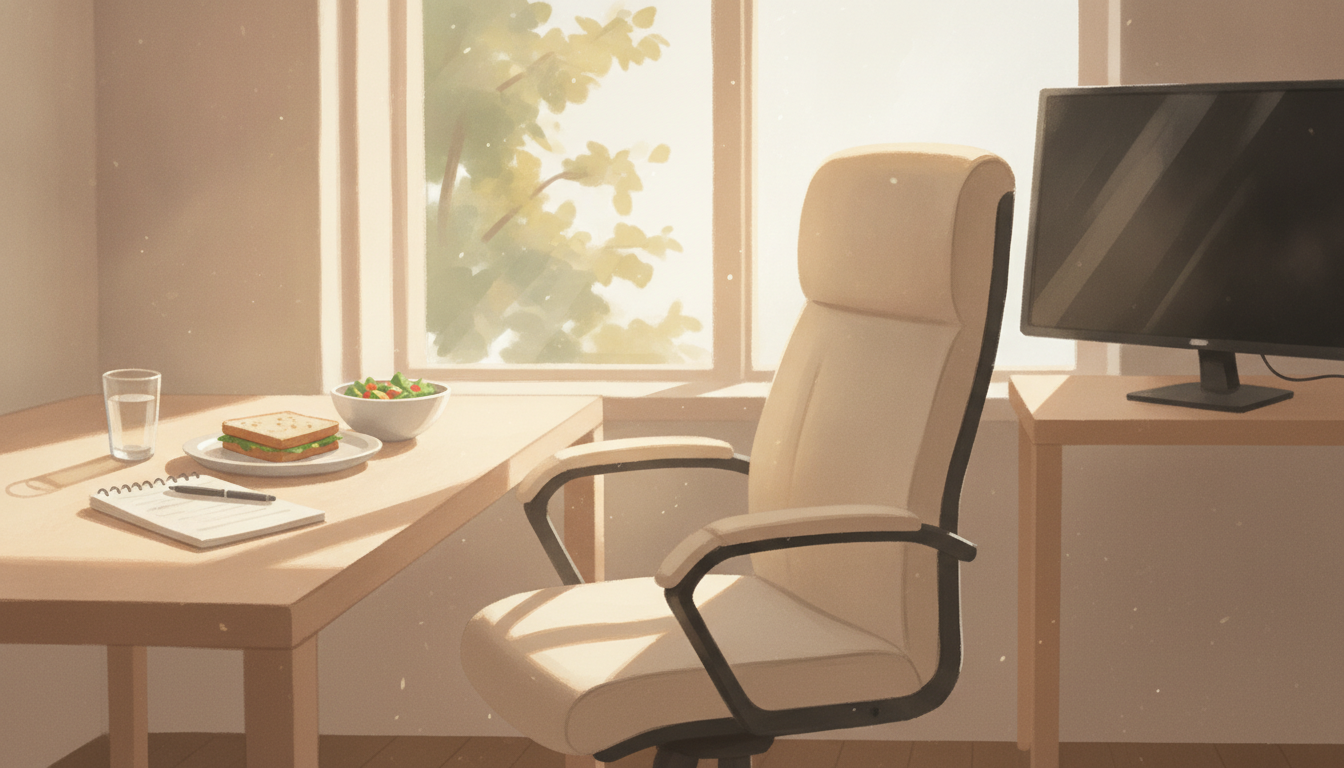
The notification badge says twelve. Your sandwich is half gone and you don't remember tasting it.
You've been scrolling between bites — a thread, an email, a headline, back to the document you were supposed to finish before two. The food is fuel. The screen is where your attention lives. Your jaw is tight from chewing while reading. Your shoulders haven't dropped since morning.
This is lunch, technically. You ate. But your body doesn't know it rested.
Fifteen minutes of not performing productivity can change your afternoon. Not because you've earned a break — though the culture will always try to frame it that way — but because eating while bracing isn't the same as eating. Because your body can't downshift when your eyes keep pulling you back into demand.
What lunch at your desk actually costs
Desk lunch looks efficient. It is, if efficiency means staying in the same posture of readiness — fingers near the keyboard, mind split, body held in low-grade activation while food goes down.
Your system reads that as continuity. No pause between tasks. No signal that one thing ended and another can wait. The afternoon begins before the morning has been allowed to settle.
You might notice it as a flatness that arrives around three. A second coffee that doesn't help. Irritability at small things. A sense that the day is long and you're already behind — even when you've done plenty.
Eating while performing rest isn't rest. Your body knows the difference even when your calendar says you took a break.
This isn't about screens being evil. It's about what happens when the one meal meant to interrupt the day becomes another tab. Another place to be useful. Another surface where you're visible, reachable, accountable to everyone except yourself.
For a lot of us, lunch at the desk became default so gradually we forgot it was a choice. There was too much to do. Leaving felt indulgent. Eating alone at a table felt like wasting time we didn't have.
But the body remembers what the spreadsheet never sees.
Fifteen minutes of nothing useful
Fifteen minutes sounds almost too small to matter.
Long enough to walk to a different chair. To eat one thing and notice its temperature, its texture. To look out a window without reading anything. To let your shoulders drop without instructing them to.
Long enough for your breath to deepen on its own. For your jaw to unclench. For the low hum of alertness — the one that says you should be doing something — to rise and fall like a wave you don't have to ride.

You might eat outside. In the break room without your phone. At the kitchen table if you work from home, with the laptop closed and the television off. Nothing to show for it except the fact that you were present for your own meal.
Even that can feel unfamiliar at first — the absence of input, the small silence where notifications usually sit. Your mind might offer boredom, or worry, or a sudden memory of everything unfinished. Let those pass through. You don't have to fill the fifteen minutes with meaning. You only have to stay in them.
That's not luxury. It's a signal — to your body, to the part of you that's been running since the alarm — that the day has a middle, and you can arrive in it.
What you'll feel when you stop
The first few lunches away from the screen might feel strange. Almost itchy.
Your hand will reach for the phone. Your mind will offer a list of things you could be catching up on. You might feel a flicker of guilt — as if sitting with a sandwich and nothing else is a small act of rebellion against a world that rewards constant availability.
That guilt isn't proof you're lazy. It's a habit asking to be seen. Many of us learned that visibility equals value — that being at our desk, being responsive, being in motion, was how we stayed safe, stayed employed, stayed good.
The urge to stay productive through lunch isn't weakness. It's a pattern that once helped you belong somewhere.
You don't have to fight the urge. Notice it. Let it sit beside you while you take another bite. Put the phone in a drawer if that helps. Eat one thing slowly — not as a mindfulness exercise, just as a way of giving your mouth something to do besides rush.
Some days you'll make it the full fifteen minutes. Some days you won't. Both tell you something about what those midday hours are holding.
What the afternoon carries afterward
The change isn't always dramatic. Some days you'll return to the screen and the afternoon will feel exactly as long as it always does.
Other days, something is different. A little more space between stimulus and reaction. A little less of the brittle edge that comes from never having stepped out of performance mode. You might eat less compulsively in the afternoon, snack less from restlessness, feel less like the day is a tunnel with no opening.
Your work will still be there. The emails won't evaporate because you ate away from your desk. What changes is the quality of attention you bring back — not sharper from grinding through lunch, but sometimes steadier from having paused.
Rest doesn't have to be long to register. Sometimes fifteen minutes of actually being somewhere is enough to change the texture of what comes next.
This isn't about becoming the kind of person who takes long lunches every day and never checks email after noon. It's about one boundary in the middle of the day — a small refusal to let the whole afternoon blur into one continuous act of proving you're still on.
For those of us who've spent years being the reliable one, the fast responder, the person who eats while working because stopping feels costly — that boundary can feel almost radical. Not because it's hard. Because it's permission to exist in the middle of the day without an audience.
A practice, not a performance
Lunch away from the screen isn't a wellness achievement. Nobody needs to know you're doing it. There's no streak to maintain, no moral high ground to occupy.
Some days the meeting runs through lunch and you eat at your desk because that's what the day required. On those days, you do what you need to do.
The practice is for the ordinary days — the ones where you have fifteen minutes and have been giving them away without noticing. Where the sandwich keeps disappearing while you scroll, and you couldn't say what it tasted like.
The plate is empty. The screen stays dark a little longer. Outside, ordinary midday — traffic, a tree moving, someone else walking somewhere without checking anything. Inside, a body that ate a meal and knew it, and an afternoon that hasn't started yet, still waiting to be met.
Related book
The Loop You're Stuck In
Keep reading
- What it means to feel less alone — even by one personYou don't need a crowd. You need one person who stays when things aren't pretty.
- Why the people who get you don't always get you right awayReal belonging takes time. The instant click is rare. The slow build is where trust lives.
- The exhaustion of performing connection without feeling itYou showed up. You smiled. You asked questions. And you drove home feeling emptier than before.