What happens when you eat a meal without a screen
The food tastes different. The silence feels loud. And something inside settles — not because you did it right, but because your attention finally had somewhere to land.
By Trupti Gavit
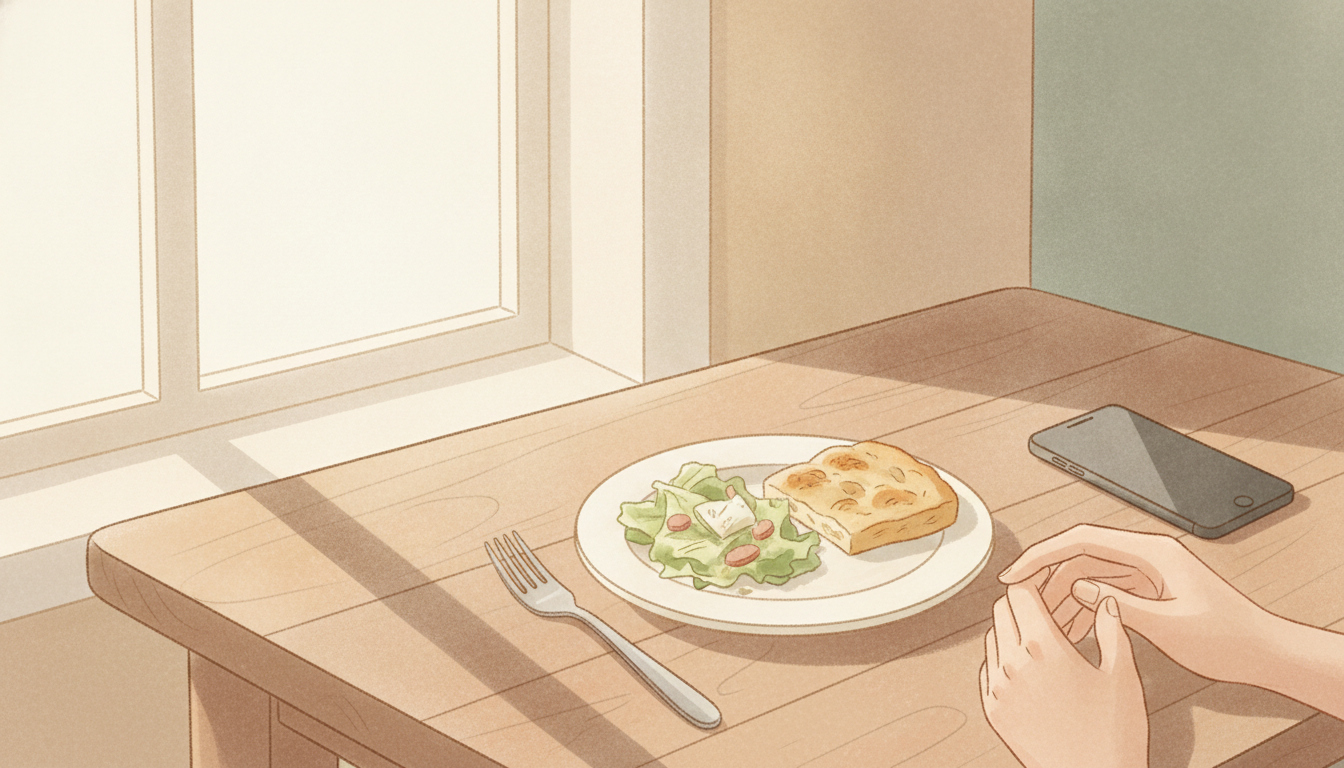
The food tastes different. The silence feels loud. And something inside settles.
You didn't plan a ritual. You didn't announce it to anyone. Maybe the phone died, or you left it in the other room by accident, or you just set it face-down and forgot to pick it back up. And then you ate — actually ate — without a screen between you and the plate.
The first few bites feel strange. Your hand reaches for something that isn't there. Your eyes don't know where to land. The room is just the room: the table, the light, the sound of your own chewing, which you almost never hear.
Then something loosens — not dramatically, not like a revelation. More like a small lowering. A weight you didn't know you were carrying loosens by a degree.
What the screen was doing at meals
Most of us eat with a screen nearby even when we don't think we do. Phone propped against the water glass. Laptop open beside the bowl. Television murmuring in the background while you chop and stir and carry the plate to the couch.
It doesn't feel like distraction. It feels like company — a way to make the meal smaller, easier, less exposed. Eating alone can feel oddly naked. The screen gives you somewhere else to be while your mouth does the work of eating.
There's nothing wrong with wanting company at a table for one. Humans have always eaten together, told stories across food, filled the space between bites with voices. A screen is a version of that — distant voices, moving images, the sense that you're not fully alone with yourself and your plate.
But a screen also splits your attention in a particular way. Part of you is chewing. Part of you is following a thread, watching a face, reading a caption. The food arrives and disappears while your mind is somewhere else — and later you might not remember what you ate, or whether you were hungry when you started, or whether you were full when you stopped.
Eating without a screen isn't about doing meals correctly. It's about noticing what was missing when your eyes were somewhere else.
When the silence gets loud
Without the screen, the meal gets bigger. Not the portion — the experience.
You taste the salt. The texture of something crisp giving way. The warmth of the bowl in your hands. Details that usually pass through unnoticed because something louder was occupying the center of your attention.
The silence can feel loud at first. Not empty silence — full silence. Your thoughts arrive without competition. The worry you were avoiding. The conversation you need to have. The low hum of what comes next that usually gets covered by a feed or an episode or the endless scroll.
You might want to reach for the phone just to soften the noise. That impulse makes sense. Stillness at a table can feel like being alone with everything you've been moving past all day.

What settles
Something settles when you stay — not because the thoughts disappear, but because they finally have a pace.
Chewing is slow. Swallowing is slow. You can't scroll through a bite the way you scroll through a feed. The body sets the tempo, and the mind, for once, has to walk at that speed.
People describe this differently. Some say the food tastes better — more vivid, more present. Some say they notice fullness sooner, or eat less without trying to, or feel satisfied in a way that has nothing to do with quantity. Some say nothing about the food at all. They say their shoulders dropped. Their jaw unclenched. The day stopped rushing for the length of a meal.
That settling isn't a reward for good behavior. It's what happens when attention lands in one place long enough to feel the ground underneath it.
A meal without a screen doesn't make you a better person. It makes the meal more visible — and visibility is its own kind of quiet nourishment.
The meals you can't eat alone
Not every meal can be screenless. Not every meal should be.
You eat at your desk because the deadline is real. You eat over a video call because someone you love is far away and that's how you share the table. You eat with a show because the day was long and your mind needs something gentle while your body refuels.
Those meals count too. They're not lesser versions of some pure ideal. They're life — messy, practical, shaped by what the day actually asked of you.
Screenless eating isn't a rule to follow or fail. It's a lens. A way of asking, when you happen to eat without a screen: What is here that I usually miss? The answer might be taste. It might be grief. It might be nothing at all except the simple fact of being fed.
Returning without forcing it
You don't have to eat every meal in silence to let this matter. One lunch on a weekday is enough to show you the difference — and the difference doesn't have to change anything if you're not ready for it to.
You might go back to eating with a screen tomorrow. You might feel relief at the return of company, of noise, of not being alone with your thoughts while you chew. That can be true too — the screenless meal wasn't a test. It was a glimpse.
And glimpses stay with you differently than rules do. They sit in the body as memory: the taste of something you actually tasted, the silence that was loud and then wasn't, the small settling that happened when you stayed at the table long enough to feel it.
You can love eating with a show on — and still remember the meal where the food tasted like food and the room felt like a room.
Holding two truths
You can eat most meals with a screen nearby — and still notice, in one meal without one, how different your attention feels when it has only one place to go.
You can want more of that settling — and still reach for the phone at lunch tomorrow because the day is heavy and you need the company.
Neither truth cancels the other. Both can sit at the same table without needing to be resolved.
The plate is empty now. The fork rests against the rim. The phone is still in the other room, and the room itself feels slightly different — as if eating without dividing your attention left a small imprint in the air, the way steam leaves a faint warmth on glass. You didn't transform anything. You ate a meal and tasted it. The silence was loud and then it wasn't. Something settled, quietly, without asking to be named. The afternoon continues. The table waits for whatever comes next — screen or no screen, hunger or fullness, the ordinary rhythm of feeding yourself one day at a time.
Related book
The Loop You're Stuck In
Keep reading
- What it means to feel less alone — even by one personYou don't need a crowd. You need one person who stays when things aren't pretty.
- Why the people who get you don't always get you right awayReal belonging takes time. The instant click is rare. The slow build is where trust lives.
- The exhaustion of performing connection without feeling itYou showed up. You smiled. You asked questions. And you drove home feeling emptier than before.