Why the first ten minutes without your phone feel different
When your hand reaches for the phone before your eyes are open—and what happens if the notifications wait just a little longer.
By Trupti Gavit
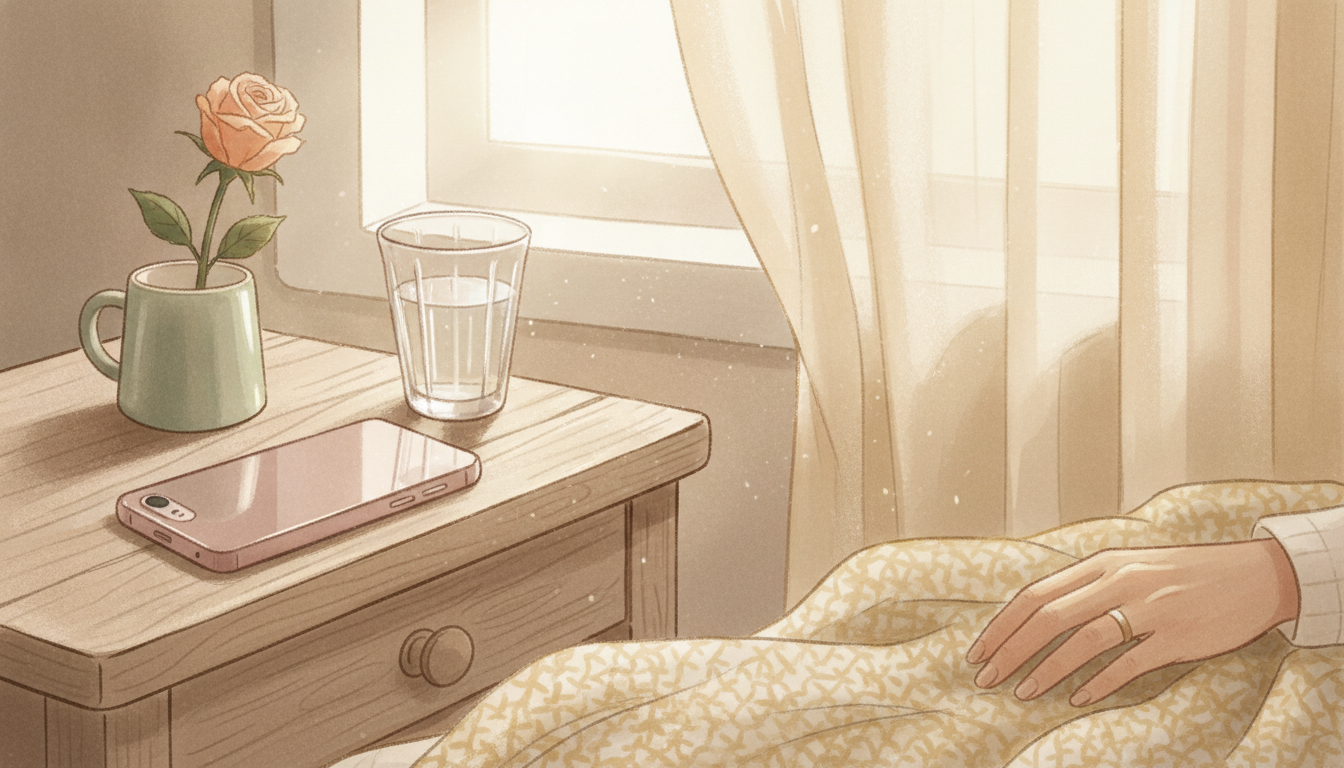
The alarm goes off and your hand is already moving — muscle memory reaching for the phone before your eyes are fully open.
Messages waiting. Headlines waiting. A whole world of other people's urgency stacked on a screen six inches from your face.
Within seconds, you're elsewhere. Not in the room where you slept. Not in the body that just woke. Somewhere between a reply you owe and a news item you wish you hadn't read and the low hum of everything you might be missing if you don't look right now.
The day hasn't started yet. But something in you is already behind.
What those first minutes actually do
The first ten minutes after waking are a threshold. You're crossing from sleep into waking — from the inner world to the outer one. Your system is soft, unguarded, still finding its footing.
When the phone is the first thing you touch, you're not easing across that threshold. You're jumping — straight into stimulation, demand, comparison, the curated noise of everyone else's mornings and opinions and needs.
Your body doesn't get to land. It gets launched.
You can't arrive in your day if someone else's urgency gets there first.
This isn't about phones being bad. It's about sequence. About who gets your first attention — the world inside your chest, or the world inside the screen.
For a lot of us, the phone became a reflex so long ago we don't remember choosing it. It was comfort during insomnia. Company during loneliness. Proof that we matter — someone reached out, something needs us, we exist in the network of other people's days.
But first-thing scrolling isn't rest. It's activation. And starting activated means spending the whole morning trying to catch up with yourself.
Ten minutes of nothing — which is actually something
Ten minutes sounds small. Almost silly.
Ten minutes is long enough for your breath to deepen without instruction. For your feet to find the floor and register that it's solid. For the light through the curtain to be just light — not a backdrop for checking something else.
Ten minutes is long enough to notice whether you woke heavy or light, anxious or quiet, already carrying something from a dream you half-remember. Information your body offers freely, if something else doesn't grab your attention first.

You might sit on the edge of the bed. Walk to the kitchen and fill the kettle. Stand at the window long enough to see one thing that isn't lit up — a bird, a branch moving, the color of the sky before it commits to the day.
Nothing productive. Nothing to show for it. Just arrival — the slow registering that you are here, in this room, in this body, before anyone else asks anything of you.
What you'll probably feel at first
The first mornings will feel strange. Maybe uncomfortable. Your hand will reach for the phone and find nothing there, and a small restlessness will rise — like you've forgotten something important, like you're already late for a life that hasn't started yet.
That's not failure. That's withdrawal from a habit that was doing more than passing time. The phone was regulating something — boredom, anxiety, the fear of being alone with your own thoughts for even a moment.
The urge to reach isn't weakness. It's a pattern asking to be seen before it asks to be changed.
You don't have to white-knuckle through it. Notice the urge. Let it pass like a wave — because it will, usually within a minute or two if you don't feed it. Put the phone somewhere you can see it but not touch it without standing up. Give your body something simple instead: water, warmth, the weight of a blanket around your shoulders, the sound of your own feet on the floor.
Some mornings you'll last all ten minutes. Some mornings you won't. Both count as data. Both tell you something about what those first seconds were holding for you.
What shifts when the order changes
Some mornings, the difference is barely noticeable. Other mornings, the day feels less like being chased — less like waking up already in debt to everyone else's needs.
You might still check your phone at minute eleven. The messages will still be there. The news will still be news. Nothing important disappears in ten minutes. What changes is the starting position — whether you begin from your own center or someone else's.
Over time, small things accumulate. You notice your mood before you absorb everyone else's. You eat breakfast tasting it, instead of scrolling past it. You hear your own thoughts before they're drowned out by other voices.
Presence isn't a permanent state. It's the first ten minutes, offered gently, again and again.
This isn't about becoming a different kind of person — the kind who meditates for an hour and never checks email before noon. It's about one boundary, placed at the softest moment of the day, that says: I get to wake up before the world asks something of me.
For those of us who've spent years being the person who responds, who shows up, who handles things — that boundary can feel almost radical. Not because it's hard. Because it's permission.
A practice, not a rule
Ten minutes isn't a moral standard. Some mornings the kids are already calling, the alarm was snoozed three times, the day is already urgent before your eyes open. On those mornings, you do what you need to do.
The practice is for the ordinary mornings — the ones where you have a sliver of choice and have been giving that sliver away without noticing.
You might extend it someday. You might not. You might add one slow breath, or a note in a journal, or nothing at all except the absence of the screen. The point isn't the ritual. It's the order: you first, then the world.
The world will wait. It always does. And you — the you that exists before the replies and the headlines and the hundred small demands — might finally get to meet the day standing still, instead of already running.
Related book
The Loop You're Stuck In
Keep reading
- What it means to feel less alone — even by one personYou don't need a crowd. You need one person who stays when things aren't pretty.
- Why the people who get you don't always get you right awayReal belonging takes time. The instant click is rare. The slow build is where trust lives.
- The exhaustion of performing connection without feeling itYou showed up. You smiled. You asked questions. And you drove home feeling emptier than before.