Why putting your phone in another room changes the room
Nothing dramatic happened — but the air got quieter and your thoughts got slower. A phone in another room changes the space you're in more than you'd expect.
By Trupti Gavit
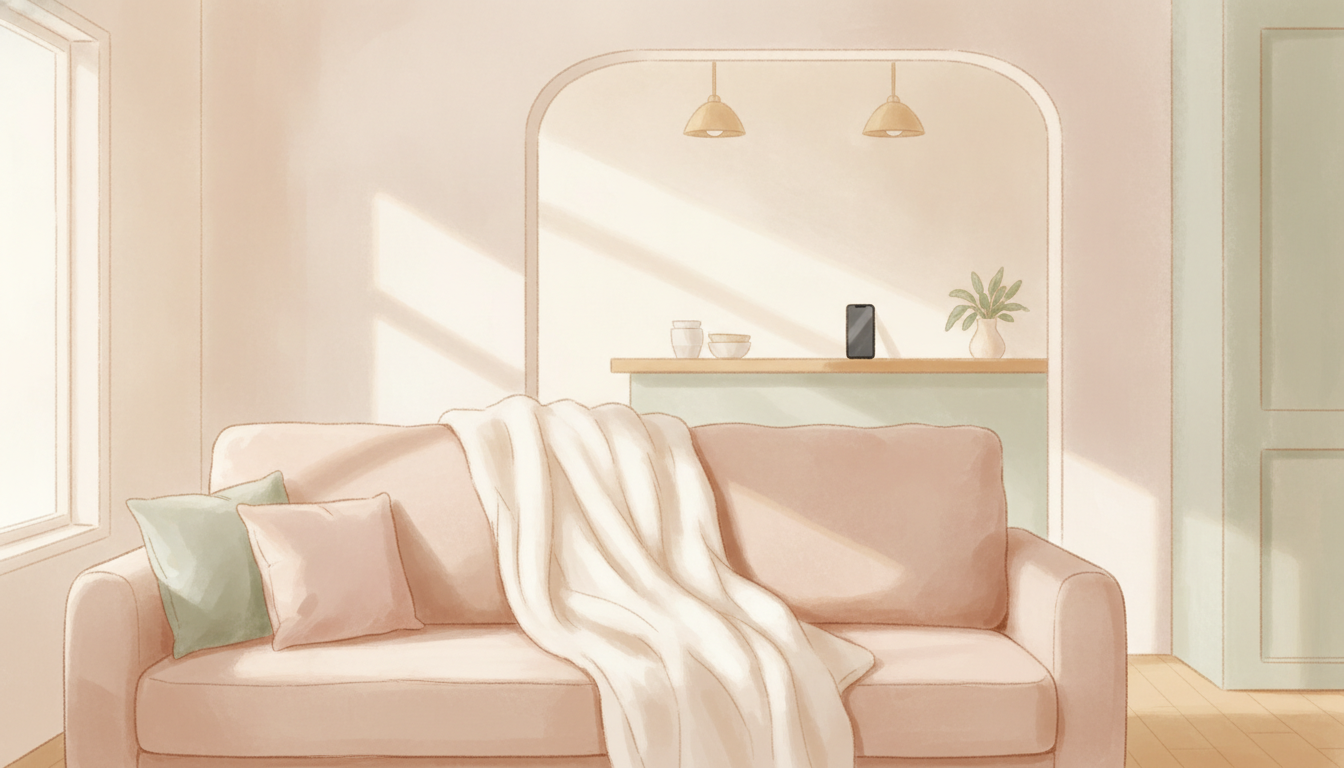
Nothing dramatic happened — but the air got quieter and your thoughts got slower.
You moved the phone to the kitchen counter. Or the bedroom dresser. Or the shelf by the door — somewhere out of reach, out of sight, still in the apartment but not in the room where you are. You didn't delete anything. You didn't make a pledge. You just put it somewhere else and walked back to the couch, the desk, the chair by the window.
The room didn't look different. Same light. Same walls. Same cup on the table, same book half-open, same afternoon continuing as it was. And yet something in the air changed — a subtle thinning of urgency, as if a small engine in the corner had stopped humming.
You can't always name what changed. You just feel it in your body: a little more room to be where you are.
The phone as part of the furniture
When the phone stays in the room, it becomes part of the room — not visually, maybe, but atmospherically.
It sits on the arm of the couch or face-up on the desk, and part of your attention stays curved toward it even when you're not looking. A low readiness. The sense that something could arrive at any moment — a message, a headline, a reminder, a small burst of novelty waiting in your pocket or on the table.
You might not feel that readiness consciously. It can register as restlessness, as difficulty settling into a book, as the urge to check something without knowing what you're checking for. The phone doesn't have to light up to pull on you. Its presence alone keeps a thread of your mind tethered to elsewhere.
Moving it to another room doesn't erase that tether entirely. But it adds friction — a small distance between impulse and action. And distance, even a few steps, changes what a room feels like to sit inside.
A phone in another room isn't punishment. It's architecture — a way of giving the room back to the person who's actually in it.
What the quiet actually is
The quiet that arrives isn't silence. The refrigerator hums. Traffic passes. Your neighbor's door closes. The quiet is internal — the lowering of background readiness, the softening of the sense that you might be needed somewhere else at any second.
Your thoughts slow down in that quiet. Not because they disappear, but because they stop competing with the possibility of interruption. You read a paragraph and it stays with you. You look out the window and the view has depth — not just a backdrop you glance at between glances at glass.
Some people feel bored at first. The room can feel too still, too unoccupied, too much like being alone with yourself without an exit. That boredom is honest. It's the feeling of a space that isn't being filled by constant small arrivals — and if you're not used to that, stillness can feel like too much at first.

The room remembers how to be a room
Rooms have rhythms that screens interrupt — not always badly, but consistently.
A room with no phone in it can return to slower rhythms. The light moves across the floor and you notice it. You finish a thought instead of abandoning it midway. You feel hunger arrive instead of discovering you've been snacking without tasting anything. You hear the silence between sounds — the tick of a clock, the breath between sentences, the small domestic noises that usually sit underneath everything else.
This isn't about becoming a different kind of person in a phoneless room. It's about the room having enough space for you to be the person you already are, without the constant option of leaving yourself through a screen.
Putting the phone elsewhere doesn't guarantee peace. You might still feel anxious, restless, lonely. But the feeling has room to be what it is instead of immediately becoming a reason to pick something up.
The room didn't change. What changed is how much of you gets to stay in it when the phone isn't on the table beside you.
When you walk to get it anyway
You will walk to the other room and pick it up. Of course you will.
Maybe because someone might have texted. Maybe because the stillness got too honest and you wanted relief. Maybe because you remembered something you needed to look up, and the need was real. Maybe for no reason you can name — just the pull, the old path your feet know by heart.
That isn't failure. It's a person in a room who chose distance and then chose proximity again. Both choices are information. The distance showed you what the room felt like without the phone in it. The walk showed you what pulled you out of that feeling.
You can put the phone back in the other room afterward. Or leave it on the couch. Or forget where you put it and find it later, buzzing softly on the kitchen counter like a small animal waiting to be noticed. The point was never permanent separation. It was seeing what the room holds when the phone isn't part of its furniture.
Small distance, large effect
You don't need to move the phone to another room forever. You don't need to do it every day. Once is enough to feel the difference — and the difference is often smaller and larger than you'd expect.
Smaller because nothing visible changed. No new habit, no dramatic life overhaul, no announcement that you're "detoxing" or "unplugging" or becoming someone who doesn't need their phone.
Larger because you felt, in your body, what it means to sit in a space that isn't also a portal. The air got quieter. Your thoughts got slower. Something in you had room to settle — briefly, imperfectly, in an ordinary afternoon that didn't require you to be anywhere else.
A phone in another room is a small act. The space it opens in you doesn't have to be small too.
Holding two truths
You can keep your phone beside you most of the time — and still notice, on the days you move it elsewhere, how differently the same room feels to sit inside.
You can walk to the other room and pick it up again — and still let the quieter afternoon matter, even when you don't stay there.
Neither truth cancels the other. Both can live in the same apartment, the same person, the same ordinary need for connection that the phone answers and complicates in equal measure.
The phone is on the kitchen counter. You're in the living room, or the study, or the chair by the window — wherever you landed when you walked back without it. The afternoon is unchanged and somehow more spacious. Your thoughts move at a pace you almost forgot they had. The air holds you differently, lightly, without asking you to stay this way forever. Later you'll get up and walk to the other room, or you won't. Either way, the room knows something now about who you are when the phone isn't part of its furniture — and that knowing stays, quiet as dust in sunlight, long after you've picked the phone back up.
Related book
The Loop You're Stuck In
Keep reading
- What it means to feel less alone — even by one personYou don't need a crowd. You need one person who stays when things aren't pretty.
- Why the people who get you don't always get you right awayReal belonging takes time. The instant click is rare. The slow build is where trust lives.
- The exhaustion of performing connection without feeling itYou showed up. You smiled. You asked questions. And you drove home feeling emptier than before.