What your phone pickup habit is actually telling you
You unlocked it before you even knew what you were looking for. The reflex isn't random — it's a small message from a body that learned to reach before it rested.
By Trupti Gavit
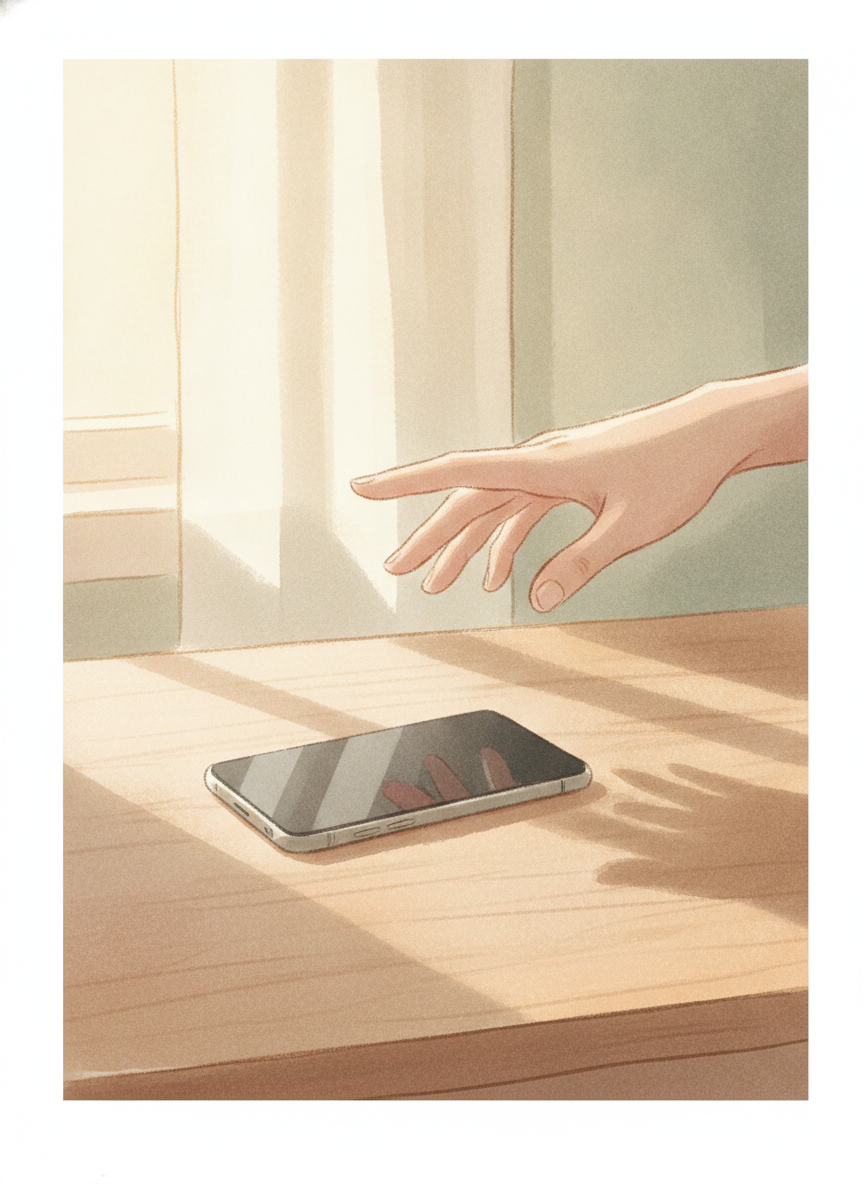
You unlocked it before you even knew what you were looking for.
You were waiting for water to boil. You were between tasks at your desk. You were sitting on the couch after a long day, not quite ready to stand up and begin the evening. Your hand moved. Your thumb found the screen. The light came on — and only then, a half-second later, did your mind arrive with a question: What did I want?
Sometimes there's an answer. A message you remembered. A headline you wanted to check. More often, there isn't. You scroll through apps you opened without choosing, pass through feeds you don't recall deciding to visit, and set the phone down ten minutes later with the faint sense that you went somewhere and can't say why.
The pickup isn't random. It's a habit — and like most habits that persist, it's carrying a message.
The reach that happens before thought
Most of us treat phone pickups as failures of discipline. A moment we should have resisted. Evidence that we're too attached, too distracted, too far from the person we mean to be.
But habits don't grow from nowhere. They grow from repetition — from the thousand small moments when reaching for the phone did something for us. Relieved boredom. Filled a pause. Offered company when the room was quiet. Gave us somewhere to put anxiety when it had nowhere else to go.
Your body learned the sequence before your mind did. Hand, pocket, unlock, scroll. Faster than a conscious decision. Faster than the question do I actually want this right now?
The pickup isn't a moral failing. It's a body remembering what used to help — even when it doesn't help anymore.
That speed matters. By the time you notice you've picked up the phone, you're already inside the habit. The light is on. The feed is moving. Stopping now requires a second decision — and second decisions are harder than first ones, especially when you're tired, or lonely, or sitting in the small empty space between one part of your day and the next.
What the pause was holding
Every pickup happens in a pause — a sliver of time the day didn't fill with a task.
Waiting for the elevator. Standing in line. The thirty seconds before a meeting starts. The moment after you send an email and don't yet know what to do next. The evening stretch when the work is done but the night hasn't begun.
Pauses used to be part of life — unscheduled, unremarkable, barely noticed. Now they're often the moments your body reaches for something to fill them.
Not because you're incapable of stillness. Because stillness, for many of us, became associated with something uncomfortable. Waiting meant being alone with a thought we didn't want. Silence meant someone might not be thinking of us. Empty time meant we weren't being useful — and for people who learned that usefulness is how you stay safe, empty time can feel almost dangerous.
The phone offers a ready answer. Something to look at. Something to do. A small hit of novelty or connection or information that says you're still in the stream, still part of things, still here.

Listening without correcting
The kind thing isn't to shame yourself every time your hand moves toward the pocket. The kind thing is to get curious — gently, without a verdict waiting at the end.
What was happening right before I reached?
Sometimes the answer is simple. Boredom. Habit. Muscle memory so deep it bypasses thought entirely.
Sometimes it's heavier. Loneliness in a quiet apartment. Anxiety about a conversation you're dreading. Grief that surfaces in unoccupied moments and feels too large to sit with without something to look at. Fatigue so deep that scrolling feels like the only kind of rest available — not rest, exactly, but a numbing that passes for it.
Your phone isn't the problem. It's the answer your body found to a question you might not have heard yet.
You don't have to stop reaching to start listening. You can notice the reach — even mid-scroll — and ask what the pause was holding. Not to judge it. Not to immediately put the phone down and declare victory. Just to hear what your body was trying to do.
Sometimes that's enough to change the next reach. Not because you've mastered anything. Because you've stopped treating the habit as evidence of a flaw — and started treating it as a conversation.
When the reach is about connection
Some pickups are genuinely about other people. A message from someone you miss. A photo you want to share. A thread where you feel seen.
Those aren't the ones that leave you empty ten minutes later. You can usually tell the difference — in how you feel when you set the phone down, in whether you remember what you looked at, in whether the reach had a name before your thumb moved.
The reflex pickups — the ones that happen in pauses, without intention — those are the ones asking to be seen. Not eliminated. Seen.
Because underneath many of them is a simple human need: to not be alone in the empty moment. To have something happen when nothing is happening. To feel the small pulse of something new when the day has gone flat.
That need isn't childish. It isn't something to outgrow. It's something to meet — sometimes with the phone, sometimes with something else, sometimes with the pause itself, if the pause can be tolerated long enough to discover it isn't as empty as it first appeared.
A habit that can soften
Habits soften when the need underneath them finds other answers — not better answers, just additional ones.
Maybe the phone stays in another room while the kettle boils, and you look out the window instead. Maybe you keep a book on the counter where your hand usually reaches. Maybe you send one message to one person before you open a feed — a real reach toward someone specific, instead of a general reach toward everything.
Maybe you do none of that, and simply start counting how many times a day you pick up the phone without knowing why. That count alone can be revealing — not as a score to improve, but as a map of how many pauses your day contains, and how rarely you stay inside them.
The phone is face-down on the table now. The screen has gone dark. Your hand rests in your lap — not because you forced anything, but because for one moment, the pause was long enough to be noticed. And in that noticing, something small and true: you weren't looking for anything. You were looking for somewhere to put the feeling of waiting. The waiting is still here. But so are you — in it, not only reaching past it.
Related book
The Loop You're Stuck In
Keep reading
- What it means to feel less alone — even by one personYou don't need a crowd. You need one person who stays when things aren't pretty.
- Why the people who get you don't always get you right awayReal belonging takes time. The instant click is rare. The slow build is where trust lives.
- The exhaustion of performing connection without feeling itYou showed up. You smiled. You asked questions. And you drove home feeling emptier than before.