Why the raise didn't change the feeling
More money arrived — but the anxiety about not having enough stayed. Why a bigger number doesn't always reach the part of you that learned to brace.
By Trupti Gavit
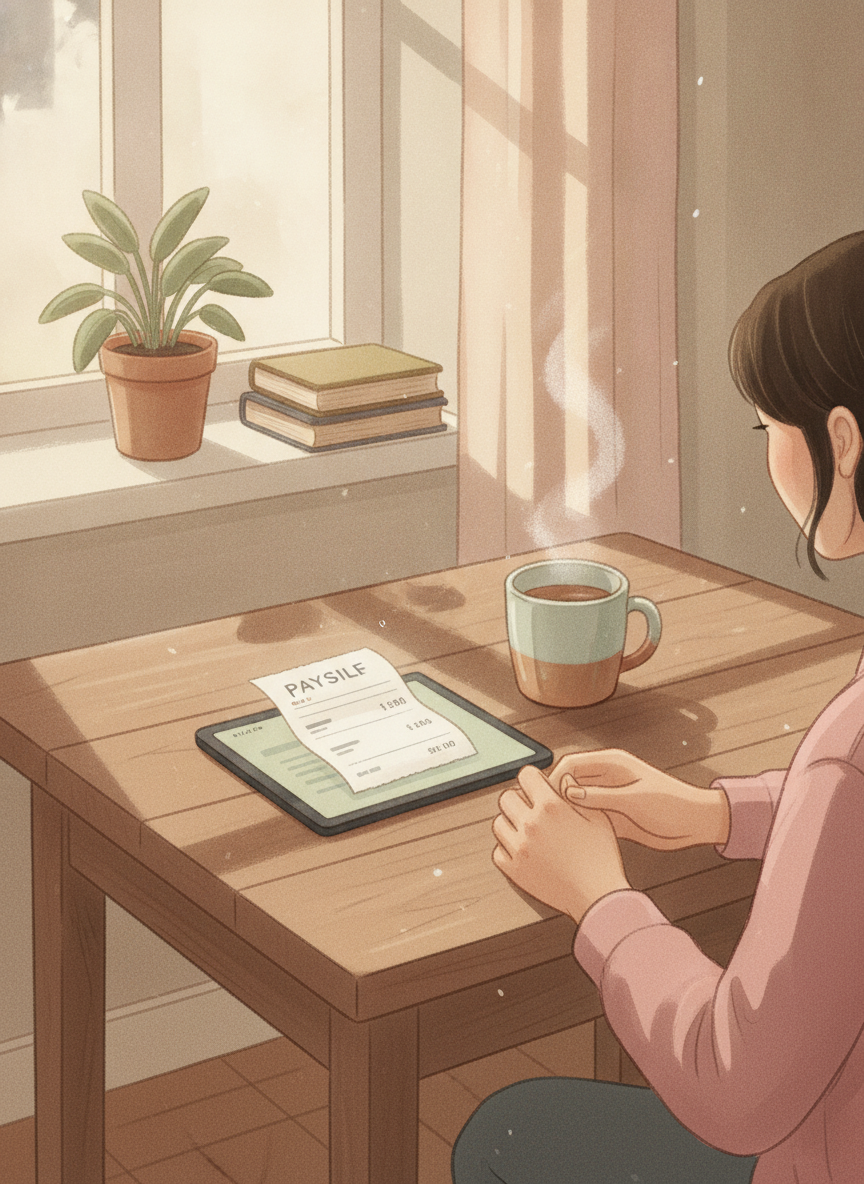
More money arrived — but the anxiety about not having enough stayed.
The email came through on a Tuesday. You read the number twice. You told your partner, or you didn't, because saying it out loud might make it less real. You did the quiet math in your head — what this means for the rent, the debt, the thing you've been putting off, the small cushion you never quite believed you'd have.
You waited for the feeling to follow. The exhale. The loosening in your chest. The sense that you could finally stop calculating every purchase like it might be the last one you could afford.
It didn't come. Or it came for an hour — a brief lightness while you sat at your desk — and then the old tightness returned, as if the raise had changed nothing that mattered.
The number changed. The body didn't.
There's a particular confusion in this moment. You did what you were supposed to do. You worked. You stayed. You earned the thing people point to when they say things get better. And still, you're lying awake running scenarios about what happens if it all disappears.
Your body doesn't read salary bands. It reads history.
Maybe you grew up watching someone stretch a paycheck across too many days. Maybe you learned that a good month could vanish without warning — a layoff, an illness, a bill that arrived wrong. Maybe you had enough once and then didn't, and it happened so fast that some part of you never fully trusted the good part again.
So now there's more in the account. More arriving each month. And the part of you that learned to brace is still bracing — still scanning, still preparing, still unable to believe this version of your life is solid enough to rest inside.
Your body doesn't update when your balance changes. It updates when your body learns, through repetition, that the ground will hold.
What more money can and can't do
More money can cover things. It can reduce the immediate pressure of a specific bill, a specific fear, a specific month where the math didn't work. That matters. It is not nothing.
But more money can't rewrite what your body learned when there wasn't enough. It can't instantly convince the part of you that still expects the floor to drop. It can't untangle years of watching love and resources get confused — the sense that having something meant someone might take it, or that you might lose it through one wrong move.
Sometimes the raise makes things louder for a while. Because now there's more to lose.
You might notice yourself checking the balance more often, not less. Unable to spend on something reasonable without a wave of guilt. Keeping money in places that feel safer even when they aren't smarter. Saying no to small pleasures you can actually afford, because some part of you is still saving for a disaster that hasn't come.
None of this means you're ungrateful. It means your body is still catching up to your circumstances.

The loneliness of feeling unchanged
You can't always explain this to people who've never had enough. They see the new number and assume the rest follows — peace, confidence, the ability to order what you want without doing math in your head.
And you can't always explain it to people who still don't have enough, either. From the outside, your worry can look like privilege. Like you should just be grateful and move on.
So you carry it quietly. You say it's great when colleagues ask about the promotion. You treat yourself to dinner and feel strange about it afterward — not because the meal wasn't good, but because some part of you is still waiting for permission that never arrives from the outside.
Having more doesn't erase what it felt like to not have enough. Both can be true at the same time.
The stories that outlive the raise
We carry money stories the way we carry old photographs — creased at the edges, faded in some places, sharp in others.
Maybe you learned that having more made you a target. That people treated you differently when they knew. That generosity was expected and saying no brought consequences.
Maybe you learned that your worth was tied to what you contributed, and having savings felt like slacking — like stopping meant you'd failed somehow. Maybe you learned that the people who were supposed to protect you couldn't, and so protection became your job. Your constant monitoring of every account, every bill, every possibility of loss.
These stories made sense when you were living them. They helped you survive. They taught you to watch, to prepare, to never assume the ground would stay steady.
The trouble is, stories don't retire on their own. They keep running in the background even when the scene has changed. And no amount of telling yourself I'm fine now will quiet them — because they don't live in the part of you that listens to reason. They live in the part that remembers the sound of your mother's voice when the check bounced. The part that knows what it feels like to choose between two necessary things and only afford one.
What gentle recalibration looks like
You can't force your body to trust a number. But you can offer it small, repeated experiences that say: This is different now. We can look. We can choose. We can stay.
Not by spending recklessly. Not by shaming the part of you that still wants to save. By noticing when the old story is running, and naming it without argument: There's the feeling that says the floor might drop. I remember that feeling. I'm also here, now, with more ground beneath me than before.
One small purchase that brings joy, made slowly, with breath. One week of checking the balance at the same time instead of compulsively. One conversation with someone you trust about the gap between your account and your body — not to be talked out of the fear, but to be witnessed in it.
Safety isn't something you arrive at once. It's something your body learns, slowly, in moments too small to photograph.
Some days you'll feel something loosen — a quiet hour where you forget to check, a purchase that doesn't come with guilt, a night where sleep arrives before the mental math. Other days the old watchfulness will return, and that doesn't mean you've gone backward. It means you're human, carrying more than one chapter at a time.
You worked hard to change the number. That matters. And the feeling in your body matters too — not as something to overcome, but as something to listen to, gently, while you teach it, bit by bit, that this ground might hold.
The payslip is still on the table. The tea has gone cold. The number is real — and so is the feeling that hasn't caught up yet. Maybe they'll meet someday, in some small ordinary moment you won't think to photograph. Until then, both can be true.
Related book
Why Money Hits So Deep
Keep reading
- What it means to feel less alone — even by one personYou don't need a crowd. You need one person who stays when things aren't pretty.
- Why the people who get you don't always get you right awayReal belonging takes time. The instant click is rare. The slow build is where trust lives.
- The exhaustion of performing connection without feeling itYou showed up. You smiled. You asked questions. And you drove home feeling emptier than before.