What happens when you say one true thing today
Not a confession — just one honest sentence you usually swallow. One small truth can shift a whole day without requiring you to become a different person overnight.
By Trupti Gavit
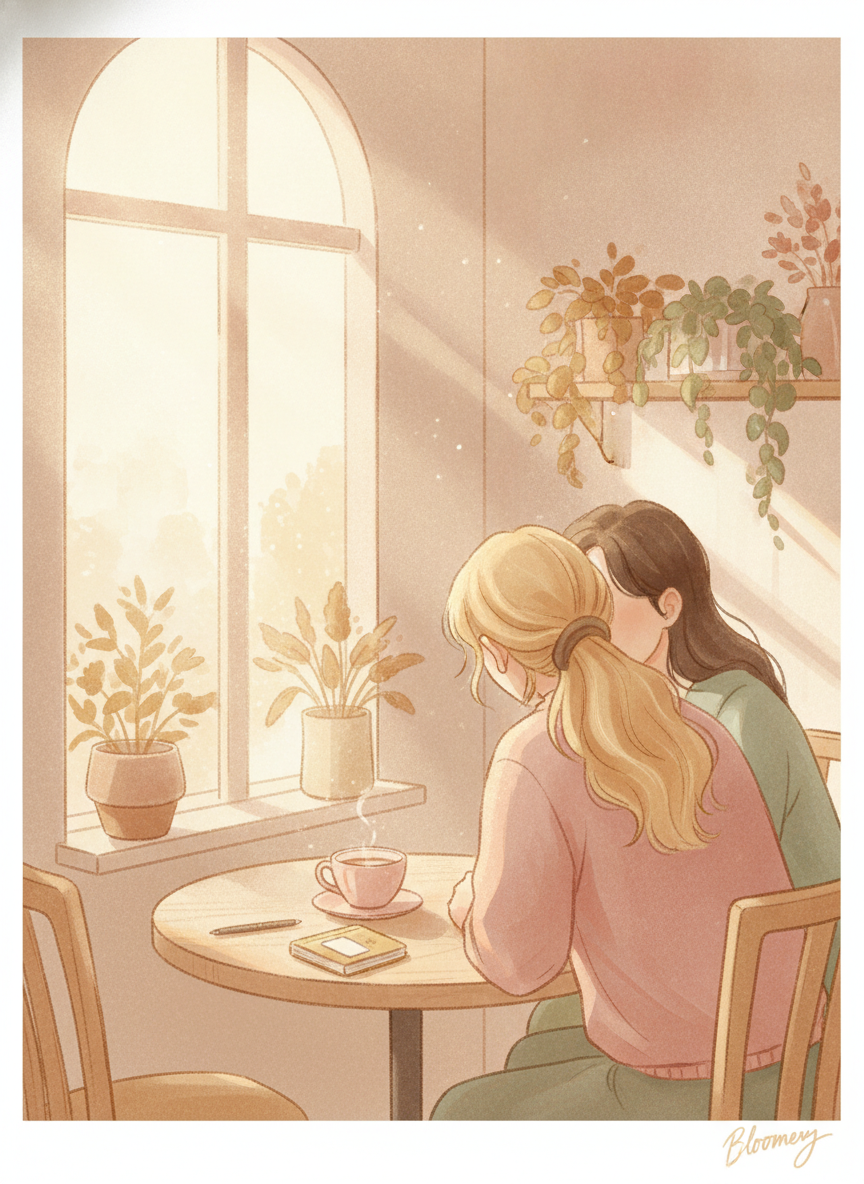
"How are you?" they ask. You say fine. You always say fine, or good, or busy — something that closes the question without opening you.
Today you say: "Actually, kind of tired. It's been a long week."
The words are small. They don't explain the whole week. They don't invite a therapy session or a rescue mission. They're just true — one sentence you usually swallow before the social reflex kicks in.
The other person nods. "Yeah, me too," they say. Or they ask one gentle follow-up. Or they simply receive it, without rushing to solve it or flinching or making it about them.
Something loosens in your chest. Not because your week changed. Because you were briefly real, and the world didn't end.
Not a confession — just one honest sentence you usually swallow.
Why one sentence is enough
Full honesty can feel like a cliff. You imagine telling the whole story — every fear, every resentment, every thing you've been carrying — and you freeze. So you say nothing. Or you perform fine, and the distance between your inner life and your outer life grows a little wider.
One true thing is different. It's a door cracked open, not a flood.
I'm nervous about this meeting. I miss my friend. I'm not sure I want to go tonight. That comment stung, actually.
These sentences don't require you to become radically transparent overnight. They don't demand that everyone in your life be ready for your full interior. They just interrupt the pattern of automatic concealment — once, in one place, with one person.
One true thing is a door cracked open, not a flood. You don't have to tell the whole story to stop performing fine.
One honest sentence, met with something other than punishment or dismissal, can leave a small imprint: Maybe I can say something real and still be okay.
Where the swallowing began
Most of us didn't start out editing ourselves. We started out saying what we felt — hungry, scared, delighted, angry — and someone responded in a way that taught us to filter.
Maybe honesty was met with dismissal. You're too sensitive. It wasn't that bad. Maybe it was used against you later. Maybe the room could only hold certain feelings, and yours didn't make the list.
So you learned to pre-edit. To scan the room before you spoke. To offer the version of truth that kept things smooth — kept you included, kept the peace, kept you from being too much.

That editing wasn't cowardice. It was skill. It helped you navigate environments where full visibility wasn't safe. The problem is, the skill outlasts the context. You keep swallowing in rooms where you could speak — with friends who would listen, partners who asked to know you, colleagues who wouldn't punish a human answer.
One true thing today is practice in noticing: Is this still one of those rooms?
What changes in the room
When you say one honest sentence, the room doesn't always transform. Sometimes the other person deflects. Sometimes they make it about them. Sometimes they offer advice you didn't ask for, and you remember why you usually stay quiet.
That's information too.
But sometimes — more often than you expect — something shifts. The conversation deepens by an inch. The other person exhales, as if your honesty gave them permission to drop their own performance. You feel less alone, not because your problem was solved, but because it was witnessed.
Honesty doesn't always change the room. Sometimes it just changes your place in it — from performing fine to standing somewhere real.
You might notice your own voice differently afterward. Softer, or steadier, or simply more yours. The gap between what you feel and what you say narrows — not everywhere, not all at once, but in that one exchange.
That's not nothing. That's a thread you can follow.
Choosing where and when
One true thing doesn't mean one true thing with everyone. You get to choose.
You might start with someone who has shown they can hold weight — a friend who listens, a partner who asked how you really are and meant it. You might start in low-stakes territory — tired, not devastated; uncertain, not unraveling.
You might write the sentence first, in a journal or a note to yourself, and say it aloud in an empty room before you say it to anyone else. That counts. Your body hears you either way.
You get to choose where one true thing lands — with someone who has shown they can hold weight, in territory that feels possible today.
Some days the true thing stays private. You're not ready. The room isn't safe. The cost of speaking outweighs the relief. That's not failure. That's discernment — the same intelligence that kept you safe when full honesty wasn't an option.
This is for the days when you could speak and usually don't. When fine is the habit, and one honest sentence is still within reach.
What it doesn't ask of you
This isn't about becoming an open book. It's not about processing every wound in every conversation, or using vulnerability as currency, or expecting one honest sentence to rewrite a relationship.
It's about one moment of alignment — where what you say matches something you actually feel, even if only partially.
You don't owe anyone your deepest material. You don't have to follow up with more truth if the first sentence is enough. You can say I'm tired and leave it there. You can say that hurt and not explain why. You can let one sentence be complete.
The café table is still there. The coffee has gone lukewarm. Your friend is talking about something ordinary now — a show, a weekend plan, the weather — and you're listening, really listening, because you're not using half your attention to hold yourself together. One sentence. That was all it took to step slightly closer to your own life.
Related book
The Loop You're Stuck In
Keep reading
- What it means to feel less alone — even by one personYou don't need a crowd. You need one person who stays when things aren't pretty.
- Why the people who get you don't always get you right awayReal belonging takes time. The instant click is rare. The slow build is where trust lives.
- The exhaustion of performing connection without feeling itYou showed up. You smiled. You asked questions. And you drove home feeling emptier than before.