What your screen time report is actually measuring
It's not how much time you spent — it's how many times you went looking for something you couldn't name, and what those small reaches might be trying to tell you.
By Trupti Gavit
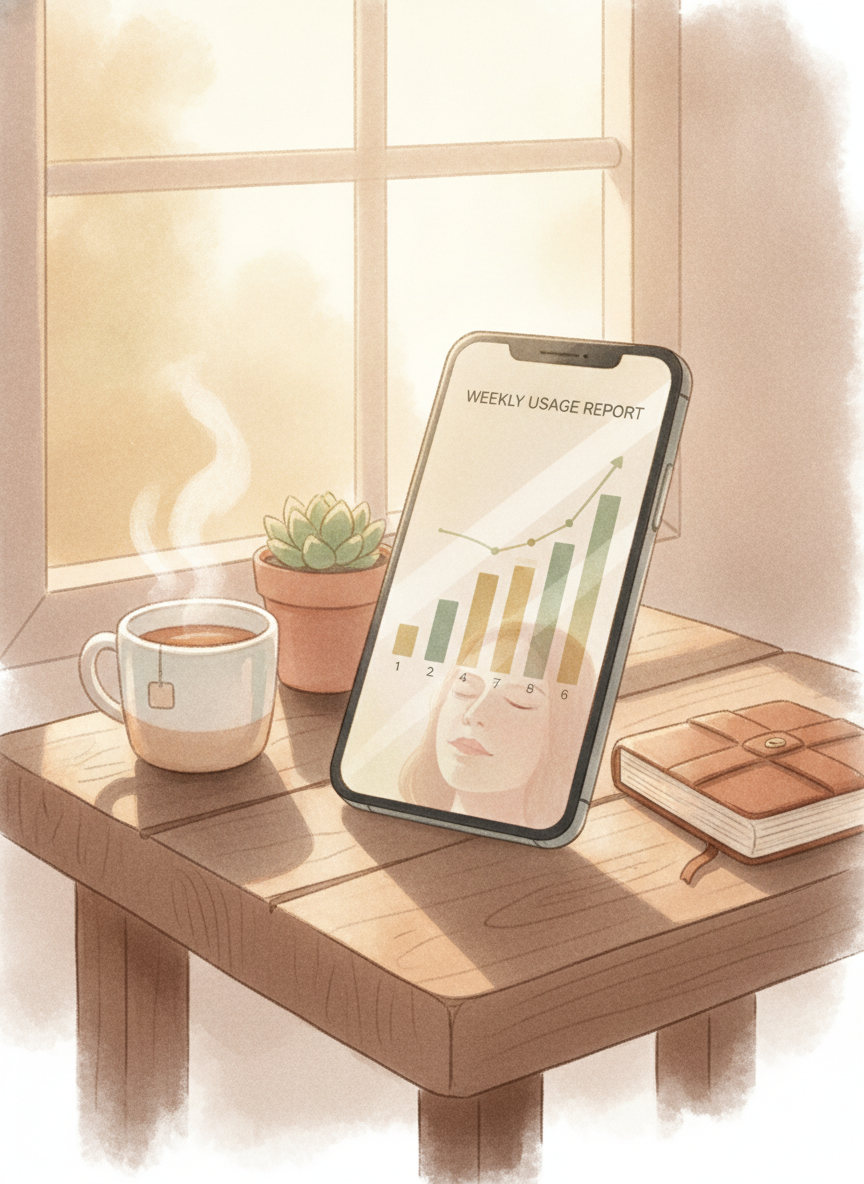
It's not how much time you spent — it's how many times you went looking for something you couldn't name.
The notification arrives on schedule — Sunday evening, or Monday morning, or whenever your phone decides to summarize your week. Four hours and twenty-three minutes. Up twelve percent from last week. Social: two hours. Safari: forty-seven minutes. The bars are colorful. The number is precise. And something in you tightens before you've read a single word.
Because the report isn't really about time. It's about reach. How many times your hand moved toward the screen without a clear reason. How many pauses got filled before you noticed they were pauses. How many moments you went looking — for connection, for relief, for something new, for nothing at all — and came back without finding a name for what you wanted.
The hours are one story. The reaches are another.
What the number can't see
Screen time reports measure duration. They count minutes inside apps, pickups per day, the slow creep of weekly totals. They do this accurately and tell you almost nothing about why.
Four hours might mean four hours of genuine connection — long calls with someone you love, photos shared, messages that mattered. Or it might mean four hours of motion without arrival — scrolling past the same kinds of images, opening apps you don't remember choosing, sitting inside feeds that leave you emptier than when you started.
The same number holds both. The report doesn't know the difference. It can't tell you how many of those minutes were spent running from a feeling, or filling a pause, or simply being too tired to do anything else.
Your screen time report counts the hours. It can't count how many times you went looking for something and couldn't say what it was.
Pickups matter more than hours
Some weeks the total hours stay flat while the pickups climb — forty, sixty, eighty times a day your hand moved toward the phone without a task attached.
Each pickup is a small departure. A moment when something in you reached before you decided to. The report may fold those into an average, but your body remembers them as separate events — the reach while waiting for coffee, the reach between emails, the reach in bed when sleep wouldn't come, the reach on the couch when the evening went quiet and quiet felt like too much.
Those reaches aren't failures of will. They're a map of how often your day contained a gap — and how rarely you stayed inside the gap long enough to discover it wasn't empty.
The shame the report invites
The report arrives with a tone that sounds helpful and often feels like judgment. Up from last week. Down from your goal. A little green arrow or a little red one, as if your week could be graded.
Shame doesn't reduce screen time. It adds a second layer — now you're not just scrolling, you're scrolling while knowing you shouldn't, while planning to be better tomorrow, while carrying the quiet belief that the number says something about who you are.
It doesn't. It says something about how your days are shaped — how many pauses they contain, how rarely those pauses are tolerated, how available the phone is as an answer to questions you haven't learned to hear yet.

Honesty without a grade
There's a different way to read the report — not as a verdict, but as a mirror held at an odd angle.
When were the heavy hours? Late night, when the day was done and the feelings arrived. Mid-afternoon, when focus dissolved and the scroll felt like the only kind of rest available. Early morning, when you reached for the phone before your feet touched the floor.
Which apps were reach apps — opened without intention — and which were choice apps — opened because you actually wanted something specific?
The report won't label them for you. But you can, if you look with curiosity instead of condemnation. Not to improve the number. To understand the pattern underneath it.
The honest question isn't how do I get this number down? It's how many times this week did I go looking for something I couldn't name — and what was I hoping to find?
What the report leaves out
It won't tell you about the week you were grieving and the phone was the only company that didn't require you to explain. It won't tell you about the long call with your sister that happened inside the "social" category and mattered more than the total suggests. It won't tell you about the three evenings you read a book instead — because the report only sees what the screen held, not what it didn't.
Both belong in the picture. The reaches and the choices. The hours lost and the hours that held you. A full week is more than a bar chart can carry.
You can hold the number in one hand and your actual life in the other. They won't always match. That mismatch is worth looking at — gently, without a verdict waiting at the end.
Holding two truths
You can want less time on your phone — and also recognize that some of those hours held real connection, real comfort, real company when nothing else was available.
You can feel stung by the number — and also know the report doesn't see grief, or the long call with your sister, or the evenings you chose a book instead.
Neither truth cancels the other. Both belong in a week that was more than a bar chart could carry.
Holding the number lightly
You can look at the report and feel something — surprise, frustration, a quiet oh of recognition — without letting it become a story about who you are.
The number is information. Not identity. Not destiny. Not a moral score.
Some weeks the number will be high because life was hard and the phone was there. Some weeks it will be lower because conditions changed — not because you became a different person, but because the days had different shapes.
The phone is face-down on the table now. The report is still there if you want to look again — same bars, same numbers, same week held in pixels. But the evening has moved on. The light is different. You went looking so many times this week, for things you couldn't always name, and you are still here — not defined by the count, not free of the pattern either, just a person who reached and returned and reached again, learning slowly what the reaching was about. The room is quiet. The number doesn't get the last word.
Related book
The Loop You're Stuck In
Keep reading
- What it means to feel less alone — even by one personYou don't need a crowd. You need one person who stays when things aren't pretty.
- Why the people who get you don't always get you right awayReal belonging takes time. The instant click is rare. The slow build is where trust lives.
- The exhaustion of performing connection without feeling itYou showed up. You smiled. You asked questions. And you drove home feeling emptier than before.