Why small decisions feel impossibly hard
You can handle big things at work — but picking a restaurant ruins your evening. When the tiny choices feel heavier than the large ones, and what your body might be carrying into the menu.
By Trupti Gavit
You closed the laptop after a day that asked a lot of you — the presentation, the difficult email, the meeting that ran long. You handled all of it. You were competent. You were fine.
Then someone said, "Where do you want to eat?" and something in you went still.
Not hungry-still. Not tired-still. The kind of still that feels like standing in front of a door with too many handles, knowing that whichever one you choose, someone might be disappointed — including you.
You can handle big things at work. But picking a restaurant ruins your evening.
When the small choice carries the whole day
Big decisions often come with structure. Deadlines. Criteria. Other people expecting you to decide, which somehow makes deciding easier — or at least makes not deciding impossible.
Small decisions arrive differently. They seem casual. Low stakes. Just pick something. And because they seem small, there's no permission to struggle with them. You can't explain to your partner why choosing between Thai and Italian feels like standing at a cliff edge. It sounds ridiculous out loud.
But your body doesn't measure stakes the way the world does.
By evening, you may have already spent your decision-making capacity on a hundred invisible choices — what tone to use in that email, whether to speak up in the meeting, how to arrange your face when something landed wrong. The restaurant question isn't one decision. It's the one that arrives when the shelf is already full.
The menu isn't heavy because you're bad at choosing. It's heavy because you've already been choosing all day without anyone counting it.
What your body is protecting when it freezes
When you stall over something small, it can feel like a character flaw. Like you should be easier, more flexible, less particular.
But freeze is often protection. Your body learned — somewhere, sometime — that choices can have costs that aren't visible on the surface. That picking wrong might mean wasting money you don't have much of. That having a preference might make you difficult. That if you choose and someone else is unhappy, you'll carry that unhappiness like it was your fault.
None of this has to be conscious. You might just feel the dread without the story attached.
And on days when you're already running close to empty — stressed, grieving, managing too much alone — even a pleasant question can feel like one more demand on a body that has nothing left to give.
The difference between big and small is often context, not capacity
At work, you might have roles, titles, expectations that grant you authority to decide. The decision is yours because the job says so. There's a script.
At home, in a relationship, with friends — the script is softer. What do you want? sounds like care. And it often is. But if you grew up scanning rooms before speaking, if your preferences were treated as inconvenient, if you learned that the safest choice was whatever kept peace — then what do you want isn't a simple question. It's a small exposure.
You might also notice that big decisions at work don't always require you to hold someone else's feelings in the same way. Choosing a vendor doesn't usually mean navigating whether your partner will feel dismissed. Choosing a restaurant might.

When every option feels like a small betrayal
Sometimes the paralysis isn't about the options at all. It's about what choosing one means leaving behind.
If you pick the place you've been to before, you might feel boring. If you pick somewhere new, you might feel anxious about whether it'll be worth it. If you defer to someone else, you might feel invisible. If you assert a preference, you might feel selfish.
Every path has a cost — not because the decision is actually catastrophic, but because you've learned to anticipate disappointment before it arrives. Your mind runs the simulations. Your body braces for the version where you chose wrong, even when wrong is just not quite what I hoped.
Small decisions feel impossible when every option comes with a story about who you might disappoint — starting with yourself.
When the menu feels too heavy
You don't need to become someone who loves choosing. You might just need to reduce what the moment is asking of you.
Sometimes that means naming it out loud — not as an apology, but as truth. I'm tapped out on decisions tonight. Can we pick one together, or can you choose and I'll be glad either way? That sentence isn't failure. It's information.
Sometimes it means giving yourself fewer options on purpose. Not because you can't handle more, but because your body is asking for less input right now. Two restaurants instead of twelve. A default on weeknights. A rotation you don't have to reinvent every Tuesday.
Sometimes it means noticing the pattern without turning it into a verdict about who you are. You freeze at small choices on hard weeks. That makes sense. It doesn't mean you'll always be this way. It means today was already full.
Holding both truths at once
You can be capable at work and undone by dinner plans. Both are real. Neither cancels the other.
The person who navigates complex projects all day might be the same person whose chest tightens when someone asks where do you want to go — because the day used up something that the question doesn't know about.
That isn't weakness. It's a body keeping honest accounts in a world that only counts the visible decisions.
Competence in one room doesn't mean your body owes unlimited ease in every other room.
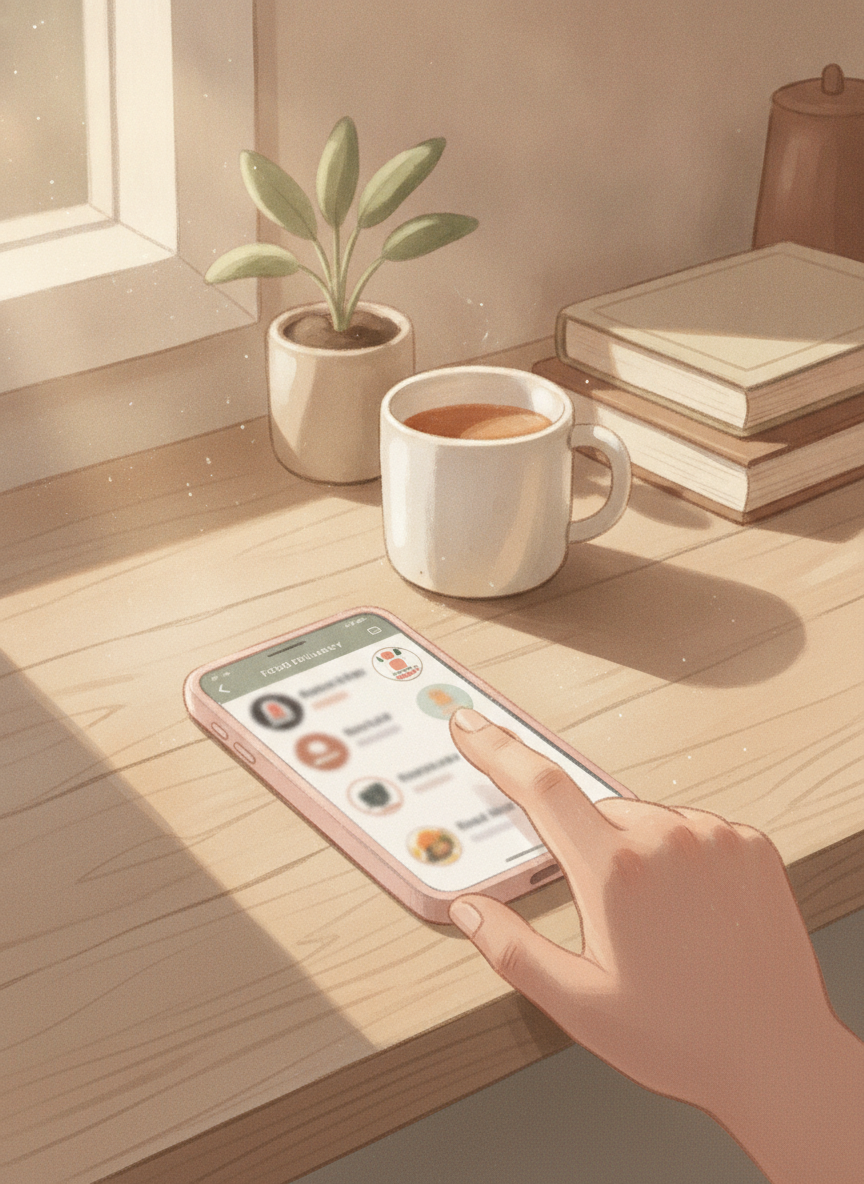
The phone is still on the counter. The apps are still open. Somewhere outside the window, evening settles into the ordinary color of a night that doesn't require a perfect choice — only a good enough one, made by someone who handled more than the menu ever knew.
Related book
Before You Know It
Keep reading
- What it means to feel less alone — even by one personYou don't need a crowd. You need one person who stays when things aren't pretty.
- Why the people who get you don't always get you right awayReal belonging takes time. The instant click is rare. The slow build is where trust lives.
- The exhaustion of performing connection without feeling itYou showed up. You smiled. You asked questions. And you drove home feeling emptier than before.