What it means to stop performing your life
The highlight reel is exhausting — and nobody's actually living one. What happens when you stop editing yourself for an invisible audience.
By Trupti Gavit
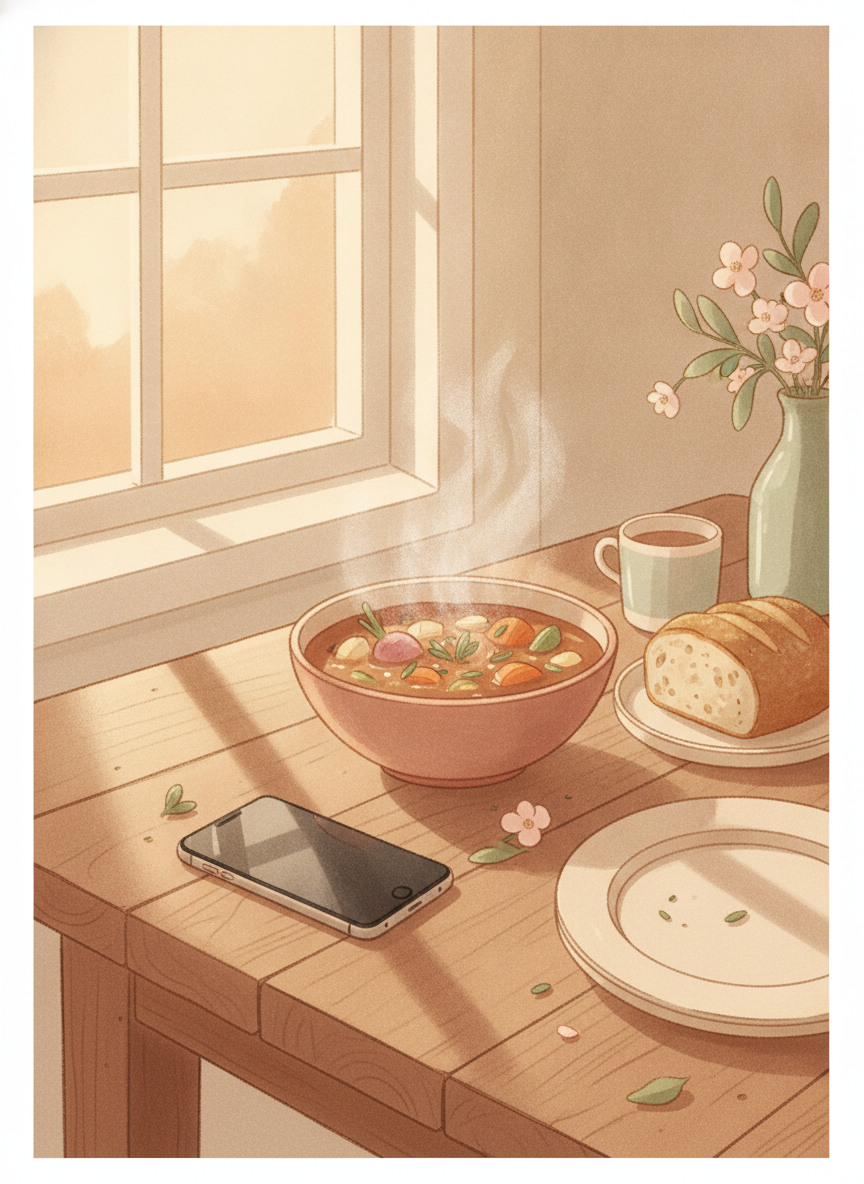
The meal looks good. You know this because you've already angled the plate, adjusted the light, found the corner of the table where the steam shows.
Your partner is waiting to eat. The food is cooling. And some part of you is still composing — not the caption, exactly, but the version of the evening that would make sense to someone watching from outside. Cozy. Intentional. The kind of life that looks like it knows what it's doing.
You put the phone down. You eat. And even then, somewhere in the back of your mind, a small audience stays seated — judging the scene for coherence, for warmth, for whether you're living up to the person you've been presenting.
The highlight reel is exhausting — and nobody's actually living one.
The audience that moved inside
Performance used to have clear borders. The stage. The interview. The room where you knew you were being evaluated and adjusted accordingly.
Now the audience is ambient. It's in the phone you haven't posted from yet. It's in the imagined reaction to a story you might tell later. It's in the way you check whether your tiredness, your doubt, your unremarkable Tuesday would make sense to people who only see the edited version.
You might not think of it as performance. You might call it being intentional, or showing up well, or caring about how you move through the world.
But performance has a particular cost: the gap between what's happening and what you're monitoring about what's happening. The meal cools while you find the angle. The conversation stalls while you craft the right response. The grief stays private because it doesn't fit the tone you've been maintaining.
When an invisible audience sits in every room, you stop living the moment and start producing it — and production, however beautiful, is still labor.
What the performance is protecting
People don't perform their lives because they're shallow. They perform because somewhere along the way, being seen became conditional.
Maybe love in your house was warmest when you were cheerful. Maybe approval arrived when you achieved, or accommodated, or made things easier for everyone else. Maybe you learned that your unfiltered self — tired, uncertain, not always articulate — was too much, or too little, or simply not what the room knew what to do with.
So you edited. Not dishonestly, at first — just carefully. You learned which parts of yourself landed well and which needed to stay backstage. You became skilled at the version that kept you included, admired, safe.
That skill isn't nothing. It got you through rooms that would have been harder to navigate raw. It built relationships, careers, a life that looks, from certain angles, exactly like the one you wanted.
But the backstage self didn't disappear. It just learned to wait — for alone time, for the friends who feel safe, for the moments when the audience finally leaves and you can stop holding your face in the shape that makes sense to everyone else.
The exhaustion nobody posts
There's a particular tiredness that comes from continuous self-surveillance.
Not the tiredness of a hard day — the tiredness of never being off. Of waking up and already considering how the morning will read. Of laughing at the party while one part of you notes whether the laugh sounded genuine enough. Of achieving something real and immediately wondering how to frame it so it doesn't look like bragging, or ingratitude, or the wrong kind of ambition.

You might scroll through other people's curated days and feel both envy and suspicion — knowing, somewhere, that the mess is just outside the frame. That nobody's actually living a highlight reel. That the person whose morning looks effortless also stood in their kitchen wondering if they were enough before the light was right.
And still, you post. Still, you perform. Because stopping feels like disappearing — like letting the room forget you, or seeing you in a way you can't control.
The highlight reel isn't a lie. It's a selection — and living inside the selection full-time is what empties you, not the sharing itself.
What stopping doesn't mean
Stopping the performance doesn't mean oversharing. It doesn't mean abandoning taste, or care, or the genuine pleasure of making something beautiful and wanting to show it.
It means noticing when the audience has become mandatory — when you can't eat the meal without composing it, can't rest without justifying it, can't grieve or doubt or sit in an unremarkable hour without feeling that you're wasting material.
It means asking, quietly: Who am I doing this for? And are they actually in the room?
Sometimes the answer is real — a person you love, a community that matters, a creative impulse that genuinely wants to share. Sometimes the answer is the old room. The parent who needed you cheerful. The culture that treats visibility as proof of existence. The version of yourself that learned that being seen was the same as being kept.
The ordinary Tuesday that counts
What lives outside the frame is usually quieter than what goes in it.
The walk without the photo. The meal eaten cold because you were hungry and didn't wait for the light. The evening on the couch with no story to tell — just a blanket, a show you're half-watching, the small relief of not being interesting for a few hours.
These moments don't prove anything. They don't build a personal brand or document a journey. They just are — and for many people who've spent years performing, just being feels almost suspiciously soft.
Like it couldn't possibly count. Like a life has to be legible to others before it counts to you.
But the unposted hours are still yours. The tired face in the bathroom mirror. The argument that didn't resolve cleanly. The morning when you didn't meditate or polish yourself or become someone worth posting — you just made coffee and stood at the window until the cup cooled.
A life doesn't become real when it's witnessed. It becomes real when you stop requiring an audience to permission your own ordinary hours.
When the room gets quieter
You won't stop performing all at once. The audience has been sitting there a long time. It learned your cues. It knows when to applaud and when to make you nervous.
What changes is the ratio — more moments where the phone stays face-down, where the story stays unposted, where you let the evening be uneven and private and not quite photogenic, and nothing bad happens.
You might notice your face relaxing when you forget to compose it. The people who love you — the real ones — often prefer the unedited version anyway. Not because they're settling, but because the edited version, however polished, keeps them at a slight distance.
You don't have to delete the apps or swear off sharing. You only have to reclaim the hours that don't belong to the audience — the ones where you're not a character, not a story, not a lesson or an inspiration. Just a person with a cooling meal and a partner waiting. Just a person on a worn rug with an unmade blanket.
The phone stays face-down. The meal is half-eaten now, still warm enough, no longer arranged. Outside, evening light fades to the color of old paper. You don't have to live every hour on display — only to let this one be yours, unwitnessed, unedited, real enough without an audience to confirm it.
Related book
What Should I Do With My Life?
Keep reading
- What it means to feel less alone — even by one personYou don't need a crowd. You need one person who stays when things aren't pretty.
- Why the people who get you don't always get you right awayReal belonging takes time. The instant click is rare. The slow build is where trust lives.
- The exhaustion of performing connection without feeling itYou showed up. You smiled. You asked questions. And you drove home feeling emptier than before.