What turning off notifications for one hour feels like
The quiet isn't empty — it's the first time you've heard yourself think. One hour without pings, and what arrives in the space they leave behind.
By Trupti Gavit
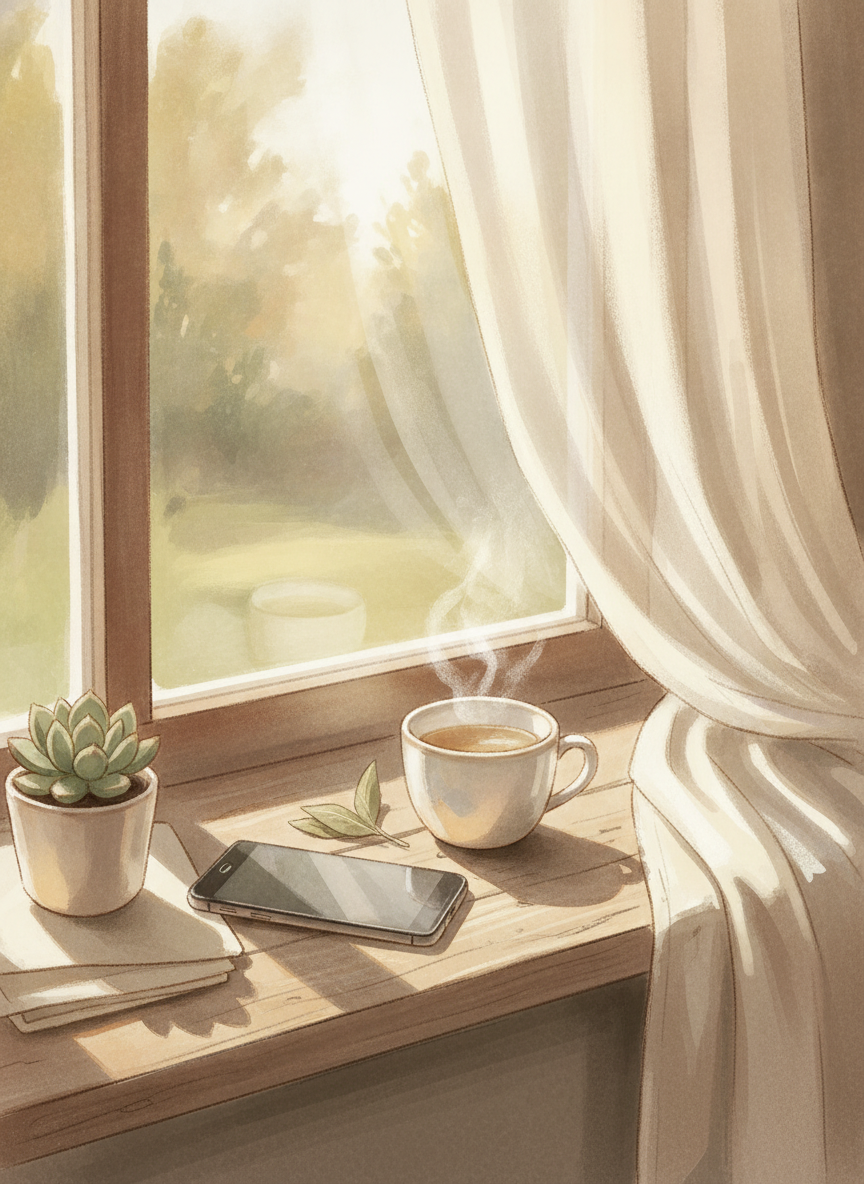
The quiet isn't empty — it's the first time you've heard yourself think.
You turned them off for one hour. Not forever. Not as a statement about technology or attention or who you want to become. Just one hour — notifications silenced, phone moved to another room or flipped face-down where you can see it but not reach it without standing up.
The first ten minutes feel strange. Your hand moves toward the empty pocket. Your mind lists what might be waiting — a message, a headline, a reminder, the low hum of everything that might need you right now if you're not looking.
Then something else arrives. Not peace, necessarily. Not calm, not yet. Just space — the unfamiliar sensation of not being summoned.
What the pings were holding
Notifications aren't neutral. They're small tugs on your attention — someone wants you, something happened, you might be missing something important if you don't look.
For a lot of us, that tug became the texture of the day. Background static. A constant low-grade readiness — as if part of you is always standing slightly, always half-turned toward the door, always prepared to respond.
You might not notice how much energy that takes until it stops.
One hour without pings and your body doesn't know what to do with itself at first. Restless. Bored, maybe. A little untethered — like you've forgotten something important, like you're already late for a life that hasn't asked anything of you yet.
Silence isn't the absence of something. It's the first time your own thoughts get to speak without competing with everyone else's urgency.
This isn't about phones being bad. It's about what fills the space when the summons pause. About who gets your attention when nothing is asking for it.
The first hour is louder than you expect
You might expect quiet to feel peaceful. Often it doesn't — not at first.
Without the constant small interruptions, thoughts you'd been outrunning have room to arrive. The conversation you're dreading. The thing you forgot to do. The feeling you've been scrolling past for weeks. The memory that surfaces for no reason at 3pm on a Tuesday.
Your body might interpret the stillness as danger — because stillness, in some chapter of your life, meant something bad was coming. Or because being alone with your thoughts has rarely felt safe. Or because busyness was how you proved you mattered — someone needs you, something is happening, you exist in the network of other people's days.

So the hour might feel uncomfortable before it feels restful. That's not failure. That's what happens when a habit loosens — when something that was doing more than passing time suddenly isn't there to do it anymore.
Notice the urge without obeying it. Let it pass like a wave — because it usually will, within a minute or two if you don't feed it. Give your body something simple instead: water, warmth, the weight of your feet on the floor, the sound of something that isn't a ping.
What arrives in the space
Somewhere in the hour — maybe minute twenty, maybe minute fifty — something shifts.
Not dramatically. Not like a revelation. More like a room getting slightly larger.
You might notice the light on the counter. The sound of a neighbor's dog. The fact that you've been hungry for an hour and didn't reach for distraction instead of food. You might finish a thought you started three days ago and never got to the end of. You might remember something you'd forgotten you cared about.
You might simply sit — not productively, not mindfully, not in any way worth posting about — and exist for a few minutes without being useful to anyone.
Presence isn't a permanent state. It's one hour, offered gently, again and again — until your body learns what quiet is for.
The messages will still be there when the hour ends. The news will still be news. Nothing important usually disappears in sixty minutes. What changes is the starting position — whether you spend the hour being pulled outward, or whether you get one small pocket of time that belongs to you.
Some hours you'll feel the difference clearly. Other hours you'll spend the whole sixty minutes restless, checking the clock, counting down to when you can turn them back on. Both tell you something about what the pings were holding for you.
Not a rule — a question
One hour isn't a moral standard. Some days the kids are calling, the deadline is real, someone you love is in the hospital and silence would feel cruel. On those days, you do what you need to do.
The hour is for the ordinary days — the ones where you have a sliver of choice and have been giving that sliver away without noticing.
You might extend it someday. You might not. You might do it once a week, or once a month, or only when the noise inside you gets louder than the noise outside. You might notice, over time, that the hour becomes easier — not because silence is always comfortable, but because your body starts to recognize it as something other than waiting for bad news.
The point isn't the duration. It's the question the hour asks: What do I hear when nothing is asking me to listen?
You can't arrive in your own life if someone else's urgency gets there first — every time, all day, without pause.
For those of us who've spent years being the person who responds, who shows up, who handles things — one hour of silence can feel almost radical. Not because it's hard. Because it's a small refusal. A way of saying: I get to exist before the world asks something of me.
What you might carry back
When the hour ends and you turn notifications on again, notice what you feel.
Relief? Dread? The familiar pull back into the stream? A slight reluctance — as if you'd started something you don't want to stop?
You don't have to change anything based on what you notice. The hour isn't a test you pass or fail. It's a way of listening — to your body, to your appetite for stimulation, to the thoughts that only arrive when nothing else is louder.
Some people find one hour becomes two, becomes a morning routine, becomes a way of beginning the day from their own center instead of someone else's. Some people do it once, feel strange, and never again. Both are information. Neither is wrong.
The phone is still face-down on the windowsill. The light has moved across the floor. For one hour, you weren't anywhere else — and maybe, briefly, you were here.
Related book
The Loop You're Stuck In
Keep reading
- What it means to feel less alone — even by one personYou don't need a crowd. You need one person who stays when things aren't pretty.
- Why the people who get you don't always get you right awayReal belonging takes time. The instant click is rare. The slow build is where trust lives.
- The exhaustion of performing connection without feeling itYou showed up. You smiled. You asked questions. And you drove home feeling emptier than before.