Why vulnerability feels like a risk your body won't let you take
You want to be closer. Something in you keeps the wall up anyway — not because you're closed off, but because your body learned what openness cost before your mind had words for it.
By Trupti Gavit
You want to be closer. Something in you keeps the wall up anyway.
You know the person is safe — or safe enough. They've shown up before. They've listened without turning away. They've shown, in the ordinary way trust accumulates, that they can hold more of you than the version you usually offer.
And still, when the moment comes to say the true thing — the worry, the hurt, the need you usually fold away — something in your chest tightens. Your throat closes slightly. The sentence forms and then retreats, replaced by something lighter, easier, more manageable.
You leave the conversation having been pleasant and go home feeling like you missed something important. Not because you chose wrong. Because your body chose before your mind finished deciding — and what it chose was protection.
When wanting closeness isn't enough
You can want intimacy and still be unable to reach for it in the moment that matters.
This isn't stubbornness. It isn't a character flaw dressed in psychology language. It's what happens when a body that learned — somewhere, somehow — that openness had consequences still runs that lesson in the background, even when the present person has done nothing to confirm it.
Your mind can know someone is trustworthy. Your body can still hesitate at the threshold, the way a hand hovers over a hot stove even when the burner has been off for years.
The gap between wanting to be known and being able to be known is one of the loneliest places to live. You can see the connection you want. You can even see the path toward it — one honest sentence, one moment of not performing fine. And your body won't let you take the step, or lets you take half of it and then pulls back before the real thing is said.
Wanting closeness and being able to receive it aren't always the same capacity. Your body may still be learning that the present room is different from the rooms that taught it to stay guarded.
What your body is protecting
Vulnerability didn't become risky in a single moment. It accumulated — in rooms where honesty changed how people looked at you, where need was met with impatience, where the true thing you said became ammunition later, or simply disappeared into silence that told you it was too much.
Your body keeps those rooms. Not as vivid memories you can narrate — sometimes not as memories at all — but as sensation. As the tightening before you speak. As the automatic edit that turns I'm not okay into I'm fine, just tired. As the laugh you add to soften a sentence that was true before you softened it.
The protection isn't irrational. It was built for environments where it made sense — where staying manageable kept you safer, or kept the connection, or kept you from being the person who ruined the mood. Your body isn't working against you. It's doing what it was trained to do: keep the tender parts folded until the room proves it can hold them.
The problem is that the training outlasts the room. You can be with someone who would hold you gently, and still feel the old bracing — still reach for the easy version because your body doesn't yet believe this room is different.
The particular risk of being seen
Being seen sounds like relief until you're in it.
There's a moment — brief, often immediately regretted — where you say the true thing and wait to see what happens. Your body is fully awake. You're watching their face, reading the micro-movements, waiting for the temperature to change, for the warmth to dim, for the person to recalculate who you are now that they know this part.
Sometimes they stay. Sometimes they don't. Sometimes they stay but differently — kinder, but more careful, as if you've become someone who needs handling. Any of those outcomes gets stored. Your body adds it to the archive: this is what openness costs.

Even when the outcome is good — when the person receives you and the connection deepens — the exposure itself can feel like too much afterward. You might lie awake replaying what you said, wondering if you shared too much, if they'll think differently, if the closeness you wanted is now tangled with the fear of having been too much.
The wall goes back up not because the vulnerability failed, but because being seen is inherently exposing — and exposure, for a body trained to stay hidden, always costs something, even when the cost buys you exactly what you were hungry for.
Your body may pull back after openness even when openness went well — not because you did it wrong, but because being seen is still, for some part of you, unfamiliar territory.
When the wall and the want coexist
You can keep the wall up and still ache for what lies on the other side of it.
You can love someone and still not be able to tell them the thing that would bring you closer. You can know, intellectually, that vulnerability is how intimacy grows — and still find your body refusing to cooperate when the moment arrives.
This isn't a puzzle to solve in one conversation. The wall wasn't built in a day, and it won't come down because you decided it should. What changes it — slowly, unevenly — is repetition. One person who stays when you say the hard thing. One conversation where nothing bad happens after you stop performing fine. One moment where you risk a small truth and the room doesn't change temperature.
Your body learns from those moments the way it learned from the harder ones — not through argument, but through experience. Each time someone meets you without flinching, without correcting, without making you regret having spoken, the wall might move a fraction. Not disappear. Move.
What small vulnerability looks like
You don't have to open the floodgates to let yourself be seen.
Small vulnerability is still vulnerability: I'm having a harder week than I'm letting on. That actually hurt my feelings. I don't know what I need, but something in me is asking for more closeness.
These sentences don't require a dramatic reveal. They don't require you to share your entire history in one sitting. They ask only that you stop editing yourself completely — that you let one true thing exist in the room and see what happens.
Some people will meet you there. Some won't. Some will try and miss. Your body will read the responses and adjust — not all at once, not permanently, but enough to know whether this person, this room, this moment is one where the wall can come down an inch.
Holding two truths
You can want to be closer — deeply, genuinely — and still feel your body keep the wall up when the moment comes.
You can know someone is safe — and still need time, and repetition, and enough small moments before your body believes what your mind already understands.
Neither truth cancels the other. Both can live in the same conversation, the same relationship, the same you who wanted to say the true thing and said the easy one instead — and who might, on some ordinary evening, try again.
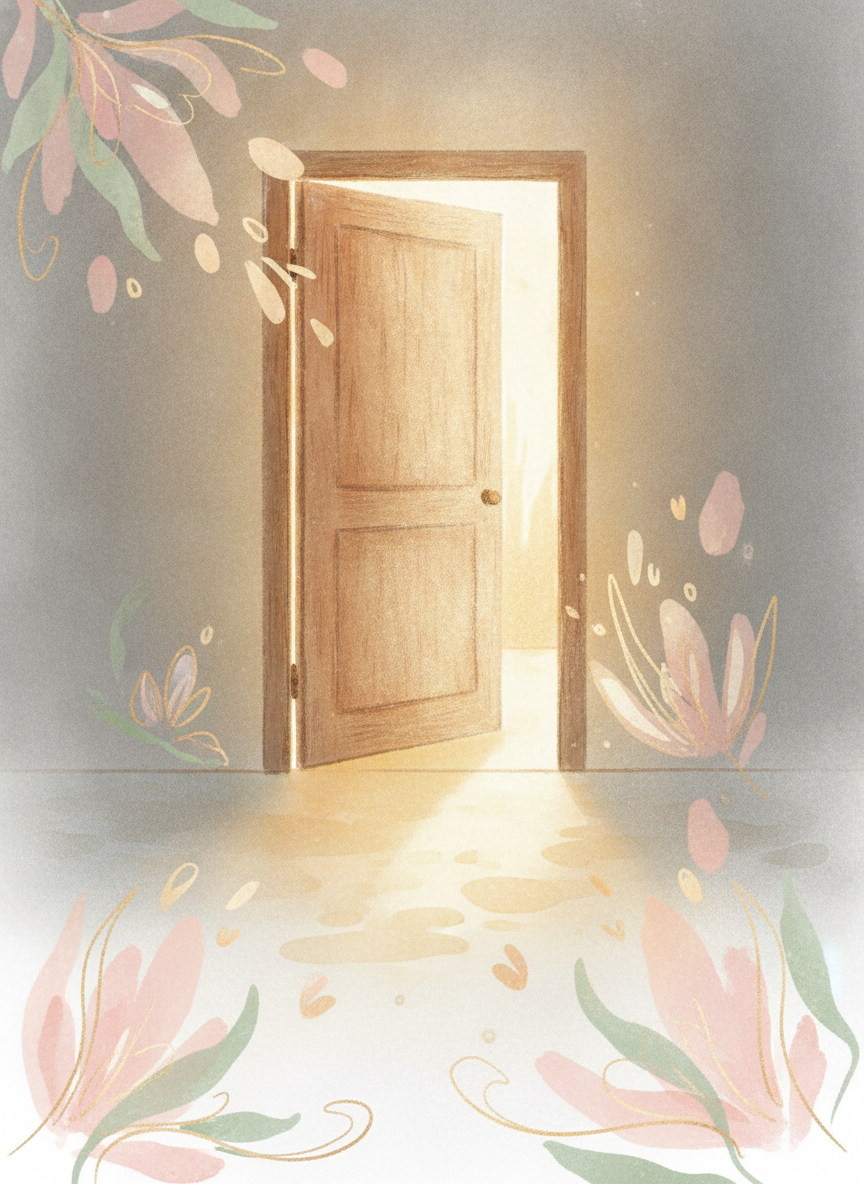
The door is still slightly open. Warm light falls across the threshold. You haven't walked through it tonight — or you walked halfway and came back, and that's its own kind of honesty. The wall and the want sit together in the quiet hallway, neither winning, neither needing to. Tomorrow someone might ask how you really are, and you might answer differently than you usually do. Or you might not. The body learns slowly. The closeness you're reaching for isn't gone because you couldn't reach it today — it's waiting, on the other side of a door you've opened before, and will open again, when the room feels safe enough to enter.
Related book
Why Love Is So Complicated
Keep reading
- What it means to feel less alone — even by one personYou don't need a crowd. You need one person who stays when things aren't pretty.
- Why the people who get you don't always get you right awayReal belonging takes time. The instant click is rare. The slow build is where trust lives.
- The exhaustion of performing connection without feeling itYou showed up. You smiled. You asked questions. And you drove home feeling emptier than before.