What happens when you walk with strangers and no phones
At first it's awkward. Then someone says something honest. And something settles — a quiet kind of connection that only happens when nobody is performing for a screen.
By Trupti Gavit
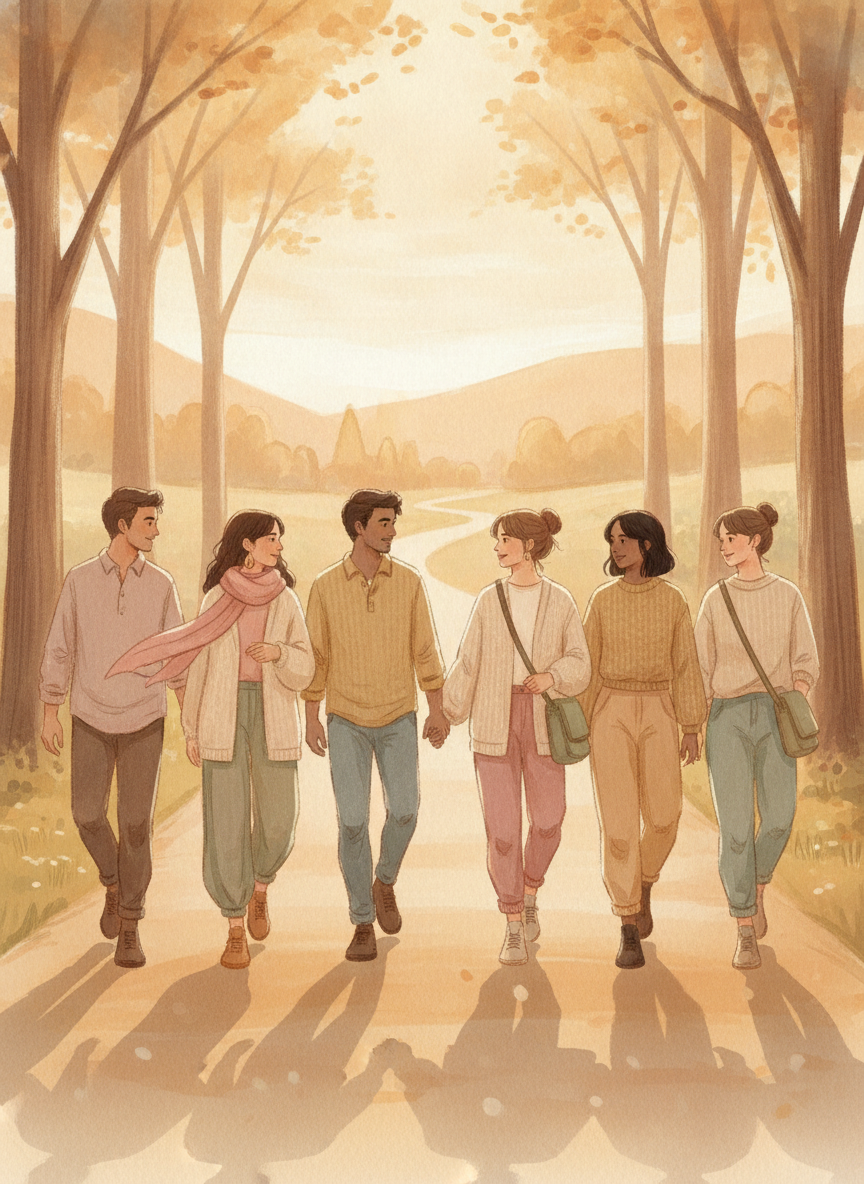
At first it's awkward. Then someone says something honest. And something settles.
You arrive not knowing anyone. A group of strangers gathered for a walk — no phones, no agenda, just a route and an hour and the particular vulnerability of being a body among bodies you haven't met.
The first ten minutes are usually the strangest. Where do you walk. Who do you talk to. Do you make small talk or stay quiet. Your hands feel too visible without a phone to hold. You notice the trees, the pavement, the pace of the person ahead, anything to have somewhere to put your attention while you figure out whether this was a good idea.
Then someone says something you didn't expect. Not profound — just honest. A small admission about being new to the city. A question about the neighborhood they haven't found the courage to ask anyone else. A laugh about getting lost on the way here. And the awkwardness loosens, not because the group has become friends, but because someone was real first, and real is contagious in a way that performance never is.
What phones take from a walk
Walking without phones removes a particular kind of escape.
You can't scroll when the silence gets uncomfortable. You can't photograph the moment instead of living it. You can't half-participate while your attention lives somewhere else — in a thread, a feed, the low hum of elsewhere that has become the background of so many in-person hours.
What's left is simpler and more exposed. The weather on your face. The sound of feet on gravel. The person beside you who might talk or might not, and either way you have to be there for it.
For people who've forgotten what undivided presence feels like, this can be disorienting at first — like standing in a room without furniture, unsure where to sit. Your body might reach for the pocket out of habit. Your mind might scramble for something to do with your hands.
And then, slowly, the walk itself becomes enough. The rhythm of moving forward together. The small observations that arise when there's nothing else to look at. The way strangers become less strange when you're sharing the same path and the same hour with no screen between you.
Without a phone, you can't perform being fine. You can only walk — and sometimes that's exactly what lets something honest arrive.
The honesty that walking allows
There's something about side-by-side movement that loosens the usual rules.
You don't have to make eye contact the whole time. The conversation can stop and start. You're not trapped in a café booth facing each other across a table — you're moving, looking ahead, letting pauses exist without them becoming failures.
People say things on walks they might not say sitting down. The admission comes out while you're both watching the path. The question gets asked because the silence felt comfortable rather than threatening. Someone mentions they're lonely, or new, or going through something, and the words land differently when neither of you is performing for an audience — when there's no record of the moment, no way to share it except by remembering.
This isn't deep friendship forming in an hour. It's something smaller and still real — the particular warmth of being briefly known by someone whose name you learned twenty minutes ago, who will probably remain a stranger after today, and who was still fully present with you for this stretch of road.
When strangers aren't scary
We're taught to be cautious of strangers, and some caution is wise.
But there's also a loneliness that comes from treating every unknown person as a threat — from moving through the world with walls up so high that connection can't get in even when it's offering itself safely, in daylight, on a public path with other people nearby.
Walking with strangers in a structured way — a group walk, a community event, a guided route — creates a container. You're not alone with one person in an empty place. You're part of something temporary and low-stakes, where the expectation isn't intimacy but presence, not forever friendship but a shared hour.

For many people, this is exactly the right amount of connection — enough to feel less alone, not so much that it asks for phone numbers or follow-ups or the vulnerability of ongoing friendship before you're ready.
Strangers can hold a kind of gentleness that old friends sometimes can't — no history, no expectations, just two people sharing a path for as long as the path lasts.
What stays after the walk ends
You might never see these people again.
That's not a failure. The walk wasn't an audition for lifelong friendship. It was an hour of being human alongside other humans — and that hour leaves something behind even when no one exchanges contact information.
You might remember the person who pointed out the heron by the creek. The conversation about nothing in particular that somehow made you feel lighter. The moment your pace matched someone else's without either of you adjusting on purpose.
Your body remembers too. The calm that arrived somewhere around minute thirty. The surprise of laughing with someone whose last name you never learned. The quiet sense that connection doesn't require knowing someone deeply. Sometimes it only requires walking in the same direction, phones away, for long enough that the awkwardness becomes something else.
Holding two truths
You can prefer your solitude — genuinely, deeply — and still feel something open on a walk with strangers.
You can find the first ten minutes awkward — and still be glad you came, still carry the hour with you into the rest of your week.
Neither truth cancels the other. Both can live in the same person who almost stayed home and walked anyway, who wanted to leave early and stayed until the path looped back to where it started.
The path is empty now, or someone is just starting out on it — a group of strangers finding their pace, pockets light without phones, the trees doing what trees do. You might have been one of them once, or you might be someday, or you might simply hold the image of what happens when people walk together without anything between them. The hour ends. The strangers disperse. Something settles anyway — in the body that walked, in the week that follows, in the quiet memory of someone saying something true while the path went on beneath your feet.
Related book
Why Love Is So Complicated
Keep reading
- What it means to feel less alone — even by one personYou don't need a crowd. You need one person who stays when things aren't pretty.
- Why the people who get you don't always get you right awayReal belonging takes time. The instant click is rare. The slow build is where trust lives.
- The exhaustion of performing connection without feeling itYou showed up. You smiled. You asked questions. And you drove home feeling emptier than before.