Why walking the same route can be its own kind of quiet
Familiar footsteps, no decisions required — your body knows the way. When repetition on a worn path becomes something more than exercise.
By Trupti Gavit
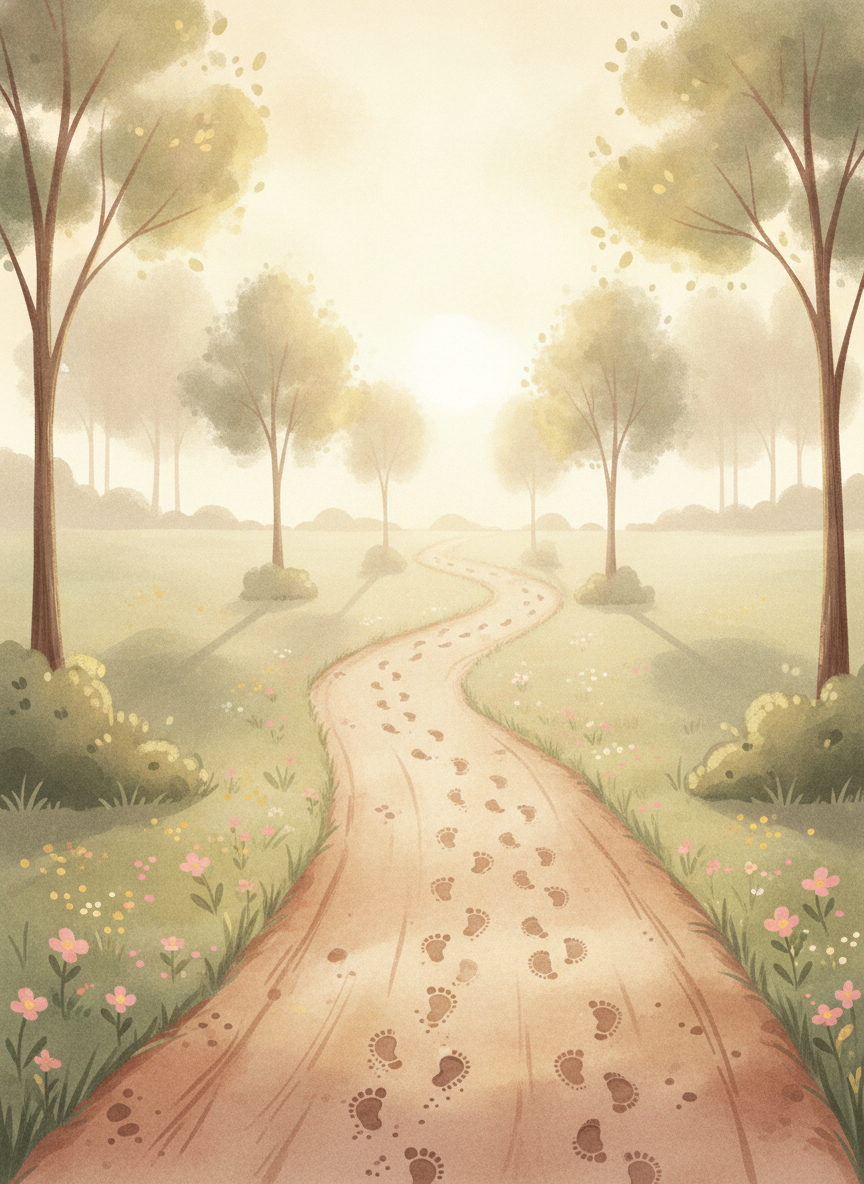
Familiar footsteps, no decisions required — your body knows the way.
You turn left at the mailbox. Past the house with the blue door. Along the fence where the cat sometimes sits. Down the slight hill, across the intersection where the light takes forever, into the park where the path curves the way it always curves.
You could walk somewhere new. People talk about that — novelty, discovery, keeping the mind fresh. And sometimes that's exactly what you need.
But today, or many days, you take the same route. The one your feet have worn into memory. The one where you don't consult your phone or choose between streets. Your body arrives at each corner before your mind has finished waking up.
This isn't boredom, exactly. It's something quieter. A small return to a path that asks nothing of you except showing up.
What repetition gives the body
New places ask for attention. Where am I going? Is this the right turn? What am I looking at? What should I notice?
The familiar route asks less. Your eyes can drift. Your breath can find its pace without you managing it. The body moves through a sequence it already knows — left, down, across, through — and something in you loosens because no part of you is on alert for the unexpected.
For people whose days are full of choosing, responding, performing readiness, a walk with no decisions can feel like setting down a weight you didn't know you were carrying. Not escape. Not achievement. Just movement along a line your feet have learned to trust.
A known path doesn't ask you to be anyone new. It only asks you to keep walking — and that can be enough.
The details that only repeat reveals
Walk the same route enough times and the world stops being wallpaper.
You notice which tree loses its leaves first. Where the puddle forms after rain and how long it takes to dry. The house that put up holiday lights in October. The bench where someone always sits in the afternoon. The crack in the sidewalk you've stepped over a hundred times — and then one day you notice a small plant growing from it.
None of this is dramatic. That's the point.
Novelty pulls your attention outward — look at this, photograph this, tell someone about this. Repetition lets attention settle inward and sideways at once. You think about nothing in particular. You think about everything you've been carrying. The walk holds both without requiring you to resolve anything.
You might arrive at the same corner and remember a conversation from three months ago — one that happened right here, mid-step. The place becomes a ledger of small inner weather. Not landmarks on a map. Landmarks in your life.

When sameness gets mistaken for stagnation
There's a cultural preference for the new. New cities, new habits, new versions of yourself arriving each season like a product launch.
Walking the same route can feel, from the outside, like you're not trying hard enough. Like your life is too small. Like growth requires disruption and anything repeated is a rut.
But sameness and stagnation aren't the same thing.
Stagnation is staying when something needs to move — a job, a relationship, a way of living that has gone flat and false. Sameness can be something else entirely: a rhythm that steadies you. A container for thoughts that need motion but not novelty. A daily reminder that your body still belongs in the world, on ground it recognizes.
You can be walking the same path and changing profoundly inside the walking. Grieving something through the same three blocks. Making a decision between the oak tree and the bench. Returning to a body that has been clenched all day and letting the familiar turns unclench it, step by step.
The route doesn't change. You do — quietly, repeatedly, in ways too small for anyone else to measure.
Leaving the walk alone
Nothing about this walk needs to be improved.
You don't need a faster pace or a longer distance or a podcast to make the time productive. You don't need to turn it into steps counted, calories tracked, mindfulness achieved. You can just walk the way you walk — maybe slow, maybe the same playlist or no playlist at all, maybe the same coat, the same hour when the light is the way you like it.
That lack of pressure is part of what soothes. The world asks so much of your attention, your improvement, your readiness to be more than you were yesterday. The same route offers the opposite: You can be exactly this. You can come back tomorrow and be this again.
For some of us, that's not laziness. It's relief. A small daily mercy in a life that rarely lets anything stay simple.
What you carry home afterward
You might not feel transformed when you unlock the door. You might feel only slightly different — a little less compressed, a little more breathed, a little clearer about something you didn't know you were thinking about until the third turn.
The walk doesn't have to produce insight. It doesn't have to solve the problem you left the house with. Sometimes it just moves the problem from your chest into your legs and back again, rearranged by motion, softened by the ordinary trees.
Some days you'll want a new path. A different neighborhood, a longer stretch, a view you haven't seen. That's fine too. The same route will still be there when you need it — patient, unremarkable, ready when choosing feels like too much and showing up is all you have.
The light is different today — lower, warmer, catching the fence the way it did last autumn and the autumn before. Your feet know the cracks. The cat may or may not be on the post. You turn left at the mailbox anyway, and the path receives you the way it always does — without applause, without asking you to be anyone other than the person who came back.
Related book
The Loop You're Stuck In
Keep reading
- What it means to feel less alone — even by one personYou don't need a crowd. You need one person who stays when things aren't pretty.
- Why the people who get you don't always get you right awayReal belonging takes time. The instant click is rare. The slow build is where trust lives.
- The exhaustion of performing connection without feeling itYou showed up. You smiled. You asked questions. And you drove home feeling emptier than before.