What your shoulders have been carrying
That ache at the base of your neck might be more than bad posture — when your shoulders hold what your mouth never got to put down.
By Trupti Gavit
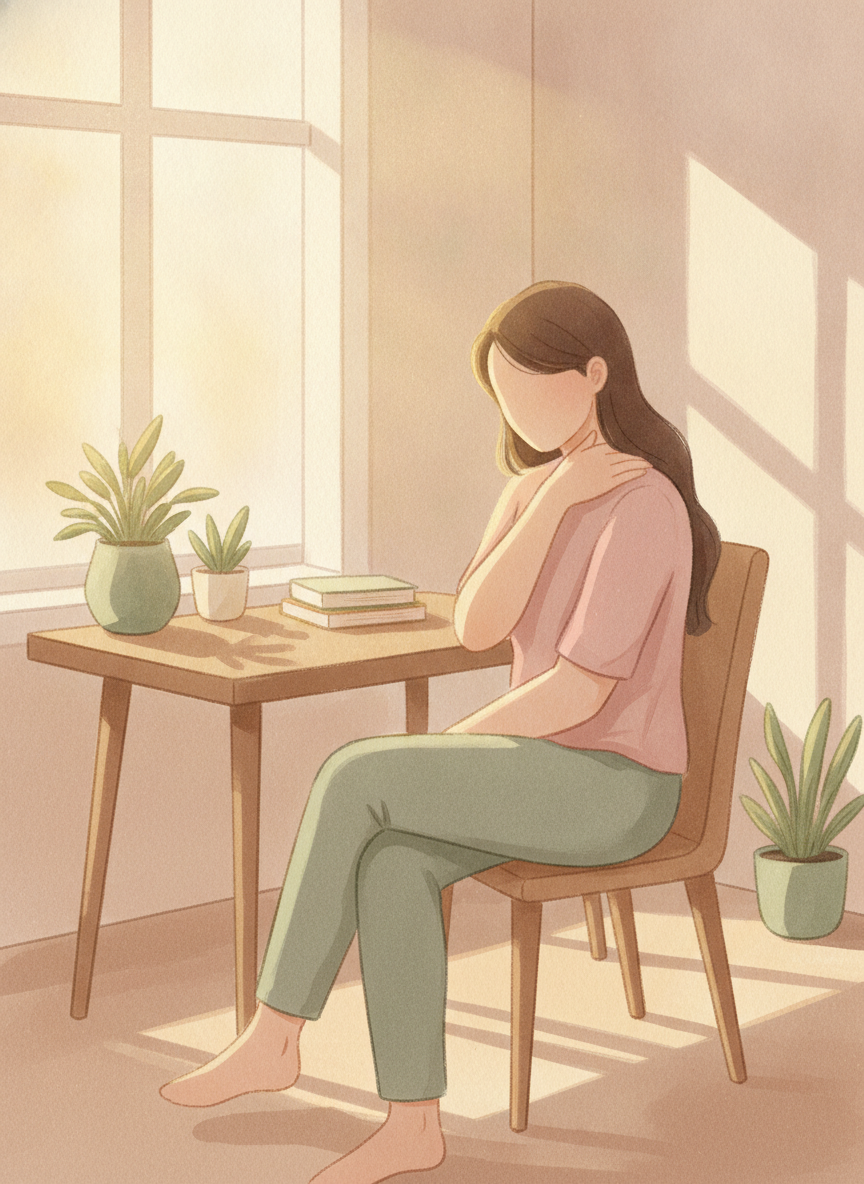
You roll your neck and hear a small click at the top of your spine. Again.
It's 4:15 on a Tuesday. You haven't lifted anything heavy. You haven't been hunched over a screen all day — or anyway, not more than usual. You stretch, you adjust your chair, you tell yourself to sit up straighter.
The ache returns within the hour, gathering at the base of your neck like something that was never fully released.
You've blamed the pillow. The commute. The way you hold your phone. All of that might be true. And still — there's a quality to this tension that feels older than today's posture. Like your shoulders have been waiting for you to notice what they've been holding since before you had words for it.
The shoulders as a shelf
The body keeps a shelf near the neck for things that didn't get put down elsewhere.
Words you swallowed in a meeting. The email you rewrote four times before sending. The worry about someone you love that you didn't name out loud because naming it would make it real. The ordinary weight of being the person who remembers, who checks, who stays pleasant when something in you is tired.
Shoulders rise without permission. They stay raised through dinner, through the shower, through the moment you lie down and realize you're still wearing the day in your trapezius muscles.
This isn't weakness. It's architecture. Your body found a place to store what couldn't be spoken or finished or handed to someone else.
Your shoulders aren't failing you. They're carrying what never found another place to rest.
What tension remembers
Neck and shoulder tightness often outlasts the moment that caused it.
You might not remember the specific Tuesday when your chest learned to brace. You might not recall every conversation where you stayed soft while something in you wanted to leave the room. But your shoulders do — not as a story you can tell, but as a shape they return to when the world asks too much and offers too little time to recover.
For some of us, raised shoulders were part of staying small. Making room. Not taking up space in houses where space was scarce or moods were volatile. For others, they became the posture of readiness — always slightly lifted, as if something might arrive from above without warning.
None of that means your body is working against you. It means it learned early that the neck and shoulders could hold what the hands were too busy to carry.

When the ache is louder than the reason
You might scan your week for the obvious cause and come up short.
No single crisis. No dramatic fight. Just the accumulation — back-to-back calls, a friend's worry, your own quiet dread about money or health or whether you're doing enough. The kind of week that looks manageable on paper and feels like sand in your joints by Thursday.
Your shoulders don't require a catastrophe to tighten. They respond to duration. To the low hum of responsibility that never fully turns off. To the feeling of being slightly on call even in your own kitchen.
The ache at the base of your neck might be less about how you sit and more about how long you've been holding yourself up.
Notice whether the tension eases when you finally leave a room — not because the problem is solved, but because your body believes, for a moment, that it can stop performing steadiness. That small release is information. Your shoulders know the difference between alone and on display.
The same ache might return Monday. That doesn't mean Sunday's loosening was wasted. It means your body is carrying something ongoing — and even brief moments of softness teach it that release is still possible.
Listening before you stretch
Most of us were taught to respond to tension by pushing through it. Roll the neck. Take a pain reliever. Sit up straighter. Keep going.
Sometimes that helps. Sometimes it adds another layer — another instruction your body has to obey while still carrying the original load.
A gentler beginning might be simpler: notice without demanding change.
My shoulders are up. Something is heavy today. I haven't put this down yet.
You don't have to name what it is. You don't have to solve it before you exhale. You only have to acknowledge that the shelf is full — that your body isn't being dramatic, it's being honest about capacity.
When you breathe and feel your shoulders drop even a millimeter, that drop isn't proof you were doing it wrong. It's proof your body still knows how to soften when it feels seen.
Small ways to set something down
Putting down what your shoulders carry doesn't always mean a long conversation or a life overhaul.
Sometimes it's closing the laptop fifteen minutes earlier and letting your arms hang heavy at your sides. Sometimes it's saying out loud, to an empty room, "That was a lot." Sometimes it's a hot shower where you don't rehearse tomorrow — just feel the water on the place where your neck meets your back.
Some people find relief in movement that isn't about performance: a slow walk without headphones, arms swinging naturally, the rhythm of steps telling the body it can stop guarding for a while.
You might also notice what happens in ordinary moments — rolling your shoulders at a red light, unclenching your jaw during a commercial break, realizing you've been holding a grocery basket like a shield. These tiny releases aren't nothing. They're your body finding a sliver of room in a day that asked too much of it.
Setting something down doesn't mean it disappears. It means your body gets a turn to not be the only place it lives.
Your shoulders may rise again tomorrow. That doesn't erase today's small release. It just means the load is ongoing — human, not proof that ease has to be earned perfectly.
Over time, the noticing itself can change the pattern. Not because you forced your body into perfect posture, but because you stopped treating the tension as something to push away and started treating it as something to hear.
That click at the top of your spine wasn't a flaw in your body. It was a small sound — your shoulders asking, again, whether anything could be set down before the day ended.
The scarf is on the chair. The light is changing. Your neck still knows the week, and maybe tonight, for a minute, something in you knows how to lean back without carrying all of it at once.
Related book
Why You Can't Rest
Keep reading
- What it means to feel less alone — even by one personYou don't need a crowd. You need one person who stays when things aren't pretty.
- Why the people who get you don't always get you right awayReal belonging takes time. The instant click is rare. The slow build is where trust lives.
- The exhaustion of performing connection without feeling itYou showed up. You smiled. You asked questions. And you drove home feeling emptier than before.