What white space on your calendar actually does
An empty block isn't laziness — it's recovery your body has been asking for. What happens when you stop filling every hour.
By Trupti Gavit
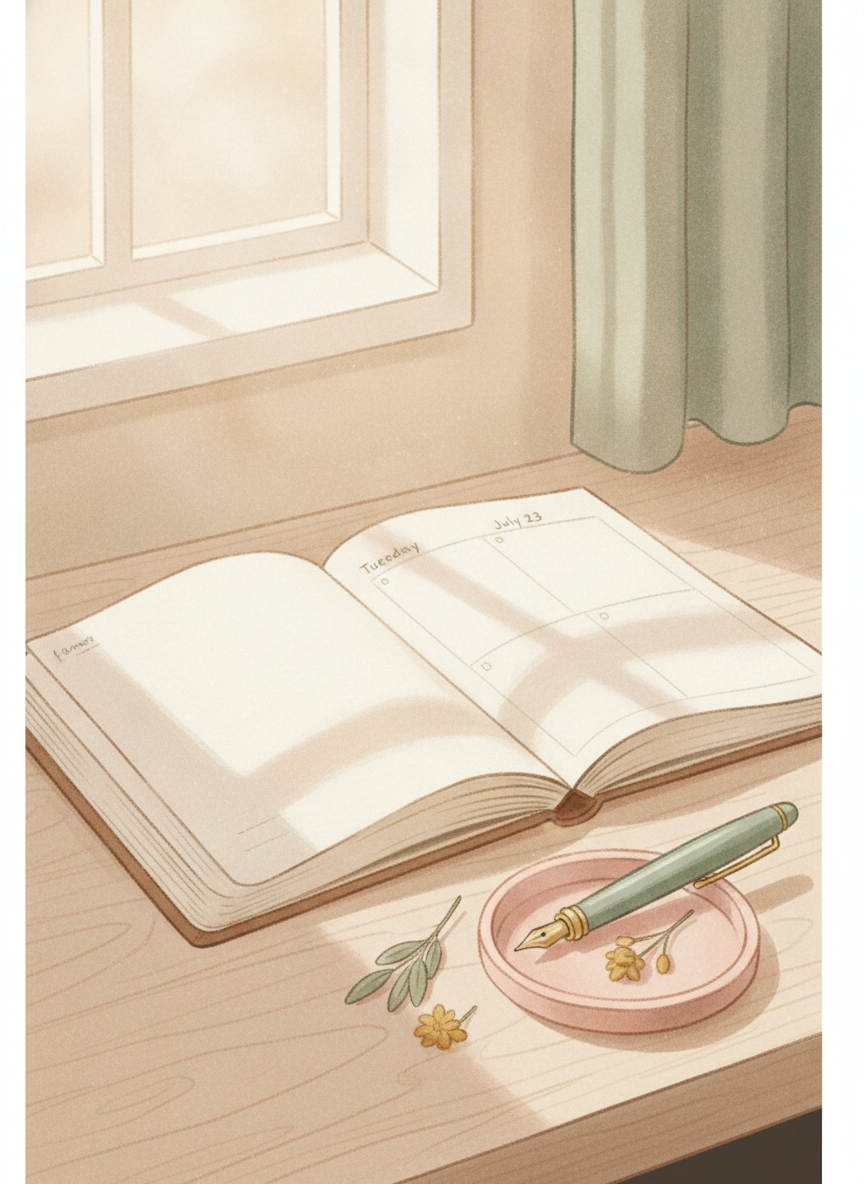
You open your calendar and there it is — a blank rectangle in the middle of the afternoon. No meeting. No errand. No color-coded obligation stretching edge to edge.
For a moment, relief arrives. Then something else follows close behind: the itch to fill it. A message you could answer. A task that would only take twenty minutes. The sense that an open hour is an hour wasted, or worse — an hour where someone might notice you're not producing anything.
You hover over the empty block like it's a mistake waiting to be corrected.
An empty block isn't laziness — it's recovery your body has been asking for.
What we've been taught empty time means
Most of us inherited a calendar philosophy without signing up for it: full equals responsible. Empty equals falling behind.
You learned it in school when free periods became study halls. At work when an open afternoon meant you weren't visible enough. At home when rest had to be earned after everything else was done — and everything else was never done.
So you fill the white space the way you'd fill a crack in a wall — quickly, before anyone notices, before your own mind starts asking what you're avoiding. Productivity becomes proof of personhood. Motion becomes the only language your body trusts.
White space on a calendar isn't absence. It's the one place your body might finally hear itself above the noise of the schedule.
This isn't about rejecting ambition or care. It's about noticing what happens when every hour belongs to something outside you — when there's no room for the slow processes that don't fit in a thirty-minute slot. Grief that arrives without invitation. Ideas that need wandering. Exhaustion that sleep alone can't lift because it isn't only physical.
What your body does with unclaimed time
When you leave a block empty and actually stay inside it — not scrolling, not "just quickly" doing one thing — something begins to shift.
At first, it might feel unbearable. Your leg bounces. Your mind lists everything you could be doing. Your chest waits, like stillness is the prelude to something going wrong. This is not failure. This is a body that learned motion equals safety — and you're offering it something unfamiliar.
If you stay a little longer, other things arrive. Not always peace — sometimes just honesty. The tiredness you've been outrunning. The conversation you've been postponing with yourself. The small grief of a week that asked too much and gave too little back.

You might notice you breathe lower. That your shoulders descend without being told. That an emotion you didn't have time to feel earlier finds its way to the surface — not as drama, but as information. This is what I've been carrying. This is what the full calendar was covering.
The difference between empty and numb
Not all unfilled time is white space.
Scrolling for an hour isn't recovery — it's anesthesia. Filling the gap with noise, tasks, or low-grade urgency isn't rest. It's the loop wearing a softer costume: still moving, still braced, still avoiding the quiet where something true might speak.
White space asks something different. It asks you to stay present in the open hour without immediately converting it into output. To let boredom visit without sending it away. To let your mind wander without grabbing it by the collar and assigning it a project.
Real white space isn't the absence of plans. It's the presence of enough safety that your body doesn't have to fill the gap to survive it.
This is why one empty afternoon can feel harder than a packed week. A packed week gives you structure. White space gives you you — and if you've spent years being useful, that can feel like standing in bright light without a role to play.
What changes when space becomes structural
One empty block won't rewrite a life built on overflow. But repeated white space — protected the way you'd protect a meeting that matters — can show your body something it hasn't felt in a while.
It learns that the world doesn't collapse when you stop. That unfinished tasks can wait an hour without becoming catastrophe. That your worth isn't tied to the density of your calendar. That recovery isn't something waiting at the end of exhaustion — it's something that keeps you from arriving there quite so often.
You might start small. One afternoon block. One Sunday morning. One evening where the phone stays in another room and the hour belongs to nothing in particular — which, it turns out, is not nothing at all.
Keeping the space without guilt
The guilt will come. It always does, at first — the voice that says you should be doing something, that rest is for later, that other people are working harder and you're slipping.
You don't have to answer that voice. You only have to notice it, name it quietly — there's the old belief that empty means failing — and stay in the chair anyway.
Over time, the ratio shifts. Not because you forced yourself to relax, but because your body collected enough evidence. Enough afternoons where nothing bad happened. Enough moments where the open hour gave back more than the filled one took. Enough Tuesdays where you noticed, afterward, that the day felt more yours — not because you accomplished less, but because something in you got to come up for air.
White space isn't a luxury you save for when you've earned it. It's part of how a human life stays livable — the margin where breath returns.
The planner is still open on the desk. The empty block hasn't been filled. Outside, the light has moved across the room — unhurried, indifferent to your schedule. Maybe that's the point. Not every hour needs a name. Some just need to be yours.
Related book
The Loop You're Stuck In
Keep reading
- What it means to feel less alone — even by one personYou don't need a crowd. You need one person who stays when things aren't pretty.
- Why the people who get you don't always get you right awayReal belonging takes time. The instant click is rare. The slow build is where trust lives.
- The exhaustion of performing connection without feeling itYou showed up. You smiled. You asked questions. And you drove home feeling emptier than before.