How the 'good child' learns to disappear
You were praised for being easy — so you made yourself smaller. The childhood pattern of disappearing into usefulness, and what it costs when no one notices you're gone.
By Trupti Gavit
You were praised for being easy — so you made yourself smaller.
You were the one who didn't cause trouble. Who ate what was served. Who did homework without being chased. Who read quietly in the corner while the adults talked about things that didn't include you — and who learned, without anyone saying it directly, that not needing much was the surest way to stay loved.
You were good. That word followed you like a shadow — warm when it landed, heavy when you realized what it cost.
Good meant manageable. Good meant no surprises. Good meant your feelings arrived in acceptable sizes, at acceptable times, in ways that didn't ask the room to rearrange itself around you.
So you disappeared — not all at once, not dramatically, but in the slow way children disappear when they learn that visibility is risky and invisibility is safer.
When being easy was the job
In some families, the good child isn't born — they're shaped. Shaped by praise when they're quiet. Shaped by relief when they don't ask for more. Shaped by the subtle message that love flows more easily toward the child who doesn't complicate things.
You might have been that child. The one who sensed when the mood was fragile and adjusted accordingly. The one who became skilled at reading faces, lowering volume, making yourself pleasant. The one who learned that your sadness was tolerable in small doses and your anger was best not shown at all.
Being good wasn't a personality trait. It was a role — unpaid, unnamed, and often invisible. You did it because the alternative felt like losing something essential. Because the good child got warmth, got included, got to stay in the room without being sent away or looked at with exhaustion.
You didn't become easy because you lacked depth. You became easy because depth, shown too openly, didn't always feel welcome.
The disappearing that nobody named
Disappearing doesn't always look like leaving. Sometimes it looks like staying — very still, very helpful, very fine.
You might have disappeared into usefulness. Into being the helper, the listener, the one who made the adults' lives simpler. You might have disappeared into compliance — agreeing before you checked whether you agreed, saying yes before you knew what you actually wanted.
You might have disappeared into silence. Into the bathroom when you cried. Into books when the house was loud. Into the version of yourself that caused no friction — even when friction, sometimes, would have meant you were real.
The adults might not have noticed. They might have been grateful — for the easy child, the low-maintenance one, the one who didn't add to their load. Gratitude isn't the same as seeing. And being useful isn't the same as being known.
What disappearing cost you
When you spend years making yourself smaller, you might lose track of your own shape.
You might not know what you want — because wanting was never the point. You might agree too quickly. You might feel a flash of resentment you immediately fold away, because good children don't resent, don't want loudly, don't make things harder.
You might still disappear now. In friendships where you're the reliable one and rarely the one who needs tending. In relationships where you anticipate your partner's mood before you've checked your own. At work where you're praised for being easy to manage — and quietly exhausted from managing everyone else's comfort.

The resentment is information. It's the part of you that didn't get airtime — still there, still waiting, still wondering when someone will ask how you are and stay for the answer.
You can be someone who loves peace and still have needed someone to notice you were in the room. Both were true. Only one got seen.
When good becomes a cage
The good child role doesn't always end when you leave the house you grew up in.
It follows you. You still read the room first. You still feel responsible for the atmosphere. You still swallow the honest thing because the honest thing might unsettle someone — and unsettling someone still feels like failure, even when you're an adult and the stakes are different.
You might not even notice you're doing it. The adjustment is so fast, so practiced, that being easy feels like being a good person rather than playing a role you were assigned before you had words for it.
Noticing is slow work. It starts with small moments — the sentence you didn't say, the feeling you edited, the I'm fine that left your mouth before you checked whether it was true.
When the good child takes up a little more room
Becoming visible again doesn't require becoming difficult. The calm is real. The sensitivity to other people's feelings is real — it has probably made you a thoughtful friend, a perceptive partner, someone who shows up with quiet understanding.
And sometimes your own feelings still wait for a seat at the table. I'm not okay sits in your throat while you check whether the room can hold it. Someone else's discomfort still registers as your emergency before you've named your own.
That can feel selfish at first. Your body might panic when you don't shrink — as if the old house is still listening, still waiting for you to make yourself manageable again.
One honest sentence can arrive before the whole history does. I'm actually not fine today. That hurt my feelings. I need a minute.
Sometimes the room doesn't collapse. Sometimes people stay. Sometimes the love you were protecting by being small wasn't as fragile as you were taught to believe.
Being good and being seen aren't the same thing. Both can be true — but only when there's room for more than someone else's comfort.
The child who learned to be easy
Somewhere in you, there's still the child who was praised for not needing much. Who learned that their tears would make things worse. Who became skilled at pleasantness, at compliance, at making the room breathe easier by taking less air.
That child was resourceful. They loved the people around them. They did what the environment asked.
They also needed someone to ask about the parts they kept hidden — the want, the anger, the loneliness that didn't fit the good child story. They needed someone to notice when the chair was still at the table but the person in it had gone quiet in a way that looked like fine.
The good child was resourceful. That part can be honored — and still given room to be whole.
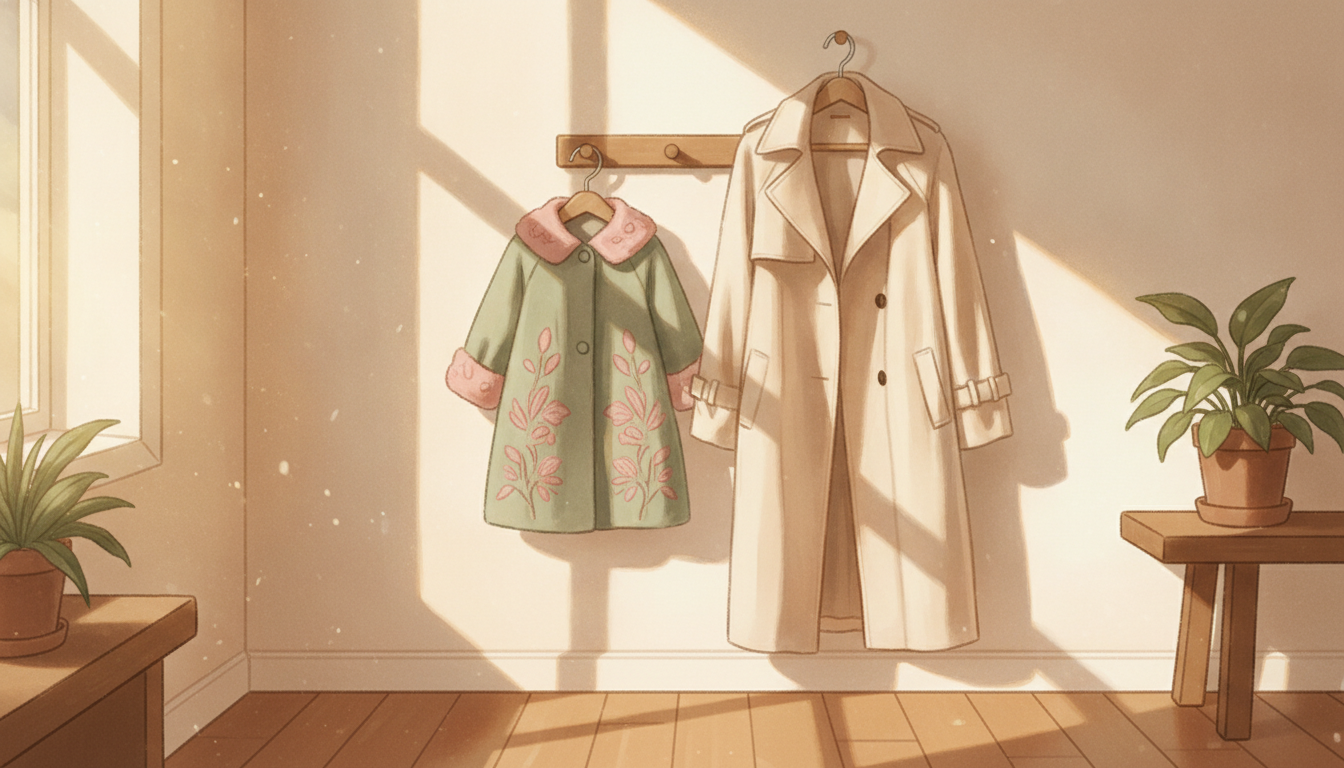
The coat is still on the hook — small beside the larger one, present but easy to overlook. Afternoon light moves across the hallway floor. Somewhere beneath the habit of being easy, something quieter is waiting — not to cause trouble, just to finally be noticed in the room.
Related book
It Started Before You Remember
Keep reading
- What it means to feel less alone — even by one personYou don't need a crowd. You need one person who stays when things aren't pretty.
- Why the people who get you don't always get you right awayReal belonging takes time. The instant click is rare. The slow build is where trust lives.
- The exhaustion of performing connection without feeling itYou showed up. You smiled. You asked questions. And you drove home feeling emptier than before.